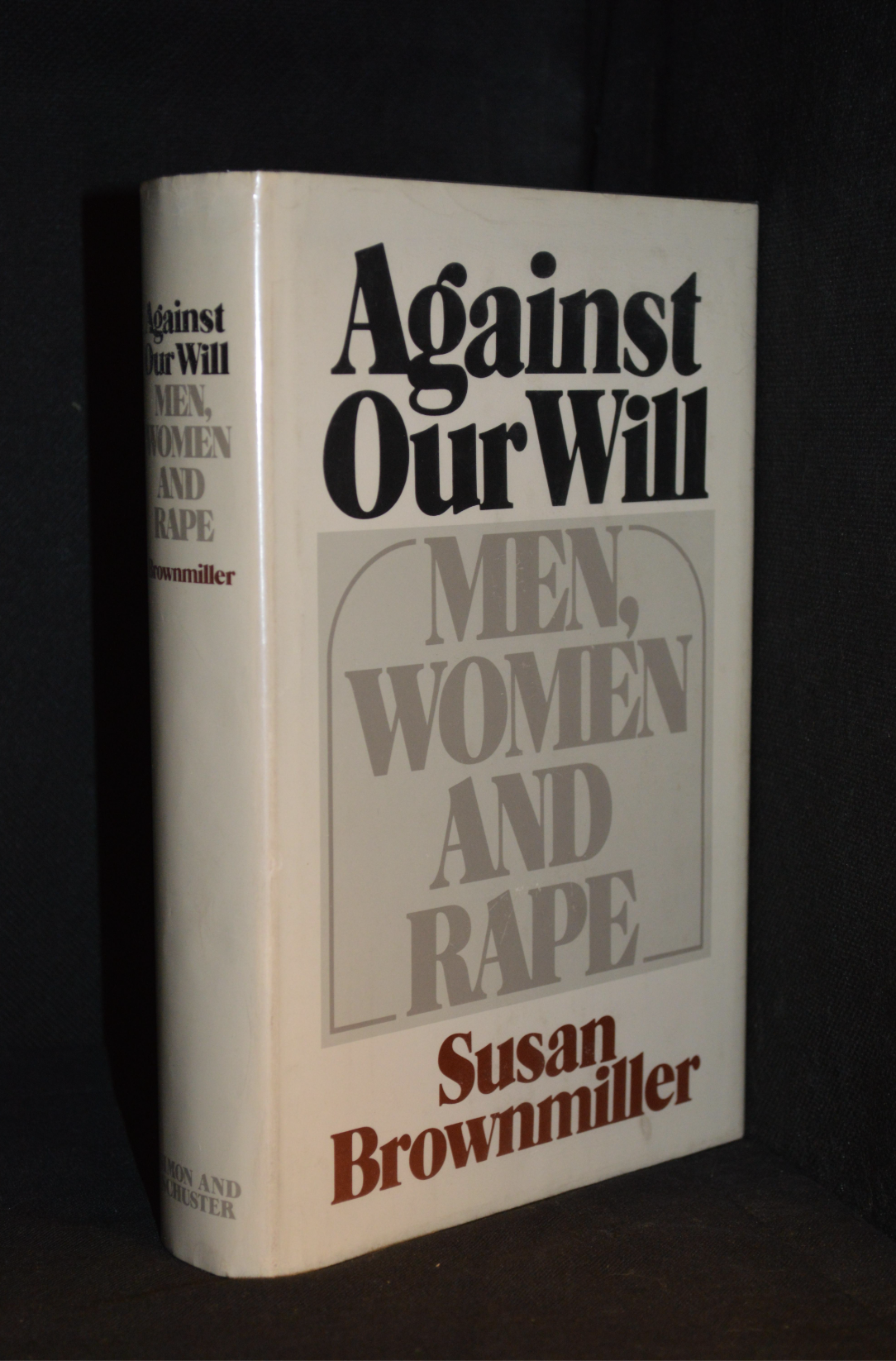
Against Our Will: Men, Women and Rape — Susan Brownmiller
Susan Brownmiller
Simon and Schuster, New York · 1975
First Edition · First Printing
The Book: True first edition, first printing of Susan Brownmiller’s Against Our Will: Men, Women and Rape. The copyright page carries the complete first-printing number line “1 2 3 4 5 6 7 8 9 10.” Original brown publisher’s cloth in the original unclipped $10.95 first-state dust jacket. No evidence of book-club manufacture, remainder marking, rebinding, ex-library provenance, or facsimile components.
Condition: Near Fine book in Near Fine dust jacket. The jacket exhibits light age toning with minimal handling wear. The book remains exceptionally clean with a tight binding, bright spine lettering, and no ownership markings, foxing, structural defects, or restoration observed.
Story Of The Book
Susan Brownmiller challenged one of society’s oldest assumptions by arguing that rape should be understood not simply as an individual act of sexual violence, but as an instrument of power.
Published in 1975 at the height of second-wave feminism, Against Our Will brought together legal history, sociology, journalism, and feminist analysis to examine how sexual violence had been understood—and frequently misunderstood—across history and institutions. Brownmiller argued that rape could not adequately be explained as an isolated crime of individual passion. Its significance had to be considered within larger relationships between gender, violence, fear, and social power.
That argument transformed a subject frequently hidden, minimized, or treated as a private misfortune into a matter of public and political concern. The book became one of the foundational works of modern feminist thought, influencing subsequent scholarship, activism, legal debate, and public discussion surrounding sexual violence.
Its importance also lies in the controversy it generated. Brownmiller offered an ambitious theory about the relationship between rape and male power that became enormously influential while also provoking substantial debate within and beyond feminism. Whatever conclusions readers draw from its arguments, Against Our Will helped permanently change the terms on which sexual violence could be discussed in public.
This first printing preserves the publication at the moment those arguments entered the wider culture, before decades of scholarship, criticism, legal reform, and activism responded to them.
Why It’s In The Collection
Against Our Will belongs in the collection because it demonstrates how publication can transform something society has normalized or marginalized into a subject that institutions are forced to confront.
Brownmiller challenged prevailing assumptions about sexual violence by reframing the question around power. In doing so, she helped move rape from the margins of public discussion into debates about law, consent, gender, human rights, and institutional responsibility. The importance of the object is therefore not dependent upon treating every argument in the book as the final word on its subject. Its significance lies in the scale of the conversation its publication helped change.
That makes the first printing especially appropriate for a collection concerned with books that altered relationships between truth, authority, and individual liberty. It preserves the original publication of a work that challenged established social understandings and contributed to a fundamental reconsideration of an issue long obscured by silence, stigma, and inherited assumptions.
Collection Categories: Free Expression · Women’s Rights · Feminism · Human Rights · Criminal Justice · Social Justice
Susan Brownmiller
Simon and Schuster, New York · 1975
First Edition · First Printing
The Book: True first edition, first printing of Susan Brownmiller’s Against Our Will: Men, Women and Rape. The copyright page carries the complete first-printing number line “1 2 3 4 5 6 7 8 9 10.” Original brown publisher’s cloth in the original unclipped $10.95 first-state dust jacket. No evidence of book-club manufacture, remainder marking, rebinding, ex-library provenance, or facsimile components.
Condition: Near Fine book in Near Fine dust jacket. The jacket exhibits light age toning with minimal handling wear. The book remains exceptionally clean with a tight binding, bright spine lettering, and no ownership markings, foxing, structural defects, or restoration observed.
Story Of The Book
Susan Brownmiller challenged one of society’s oldest assumptions by arguing that rape should be understood not simply as an individual act of sexual violence, but as an instrument of power.
Published in 1975 at the height of second-wave feminism, Against Our Will brought together legal history, sociology, journalism, and feminist analysis to examine how sexual violence had been understood—and frequently misunderstood—across history and institutions. Brownmiller argued that rape could not adequately be explained as an isolated crime of individual passion. Its significance had to be considered within larger relationships between gender, violence, fear, and social power.
That argument transformed a subject frequently hidden, minimized, or treated as a private misfortune into a matter of public and political concern. The book became one of the foundational works of modern feminist thought, influencing subsequent scholarship, activism, legal debate, and public discussion surrounding sexual violence.
Its importance also lies in the controversy it generated. Brownmiller offered an ambitious theory about the relationship between rape and male power that became enormously influential while also provoking substantial debate within and beyond feminism. Whatever conclusions readers draw from its arguments, Against Our Will helped permanently change the terms on which sexual violence could be discussed in public.
This first printing preserves the publication at the moment those arguments entered the wider culture, before decades of scholarship, criticism, legal reform, and activism responded to them.
Why It’s In The Collection
Against Our Will belongs in the collection because it demonstrates how publication can transform something society has normalized or marginalized into a subject that institutions are forced to confront.
Brownmiller challenged prevailing assumptions about sexual violence by reframing the question around power. In doing so, she helped move rape from the margins of public discussion into debates about law, consent, gender, human rights, and institutional responsibility. The importance of the object is therefore not dependent upon treating every argument in the book as the final word on its subject. Its significance lies in the scale of the conversation its publication helped change.
That makes the first printing especially appropriate for a collection concerned with books that altered relationships between truth, authority, and individual liberty. It preserves the original publication of a work that challenged established social understandings and contributed to a fundamental reconsideration of an issue long obscured by silence, stigma, and inherited assumptions.
Collection Categories: Free Expression · Women’s Rights · Feminism · Human Rights · Criminal Justice · Social Justice