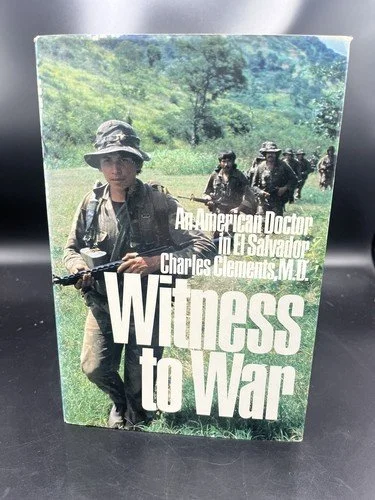
Witness to War — Charles Clements
Full Title: Witness to War: An American Doctor in El Salvador
Charles Clements, M.D.
Bantam Books, New York · 1984
First Edition · First Printing · Signed & Inscribed
The Book: First edition, first printing of Charles Clements’s Witness to War: An American Doctor in El Salvador. The copyright page carries the complete printer’s number line FG 0 9 8 7 6 5 4 3 2 1, with the 1 present, confirming first-printing status. Original black cloth spine over gray paper-covered boards in the original unclipped $15.95 first-state dust jacket. This presentation copy is warmly inscribed and signed by Clements to Pat and Herbert Pratt, dated January 16, 1990. No evidence of book-club manufacture, remainder marking, rebinding, ex-library provenance, or facsimile components observed.
Condition: Near Fine book in Near Fine dust jacket. The book remains clean and tight with bright spine lettering and no ownership markings beyond the author’s presentation inscription. The original dust jacket shows only light age toning and minimal handling wear, with no significant tears or losses observed.
Story Of The Book
Charles Clements entered El Salvador as a physician and came to believe that medicine required public witness as much as private care.
Published in 1984, Witness to War brought the Salvadoran Civil War to American readers through the eyes of a doctor treating civilians caught in one of the Cold War’s most violent conflicts. Rather than observing from a distance, Clements wrote from hospital wards, refugee camps, and villages devastated by political violence. His account combined medical testimony with political observation, placing individual suffering at the center of a conflict too often described only through military strategy and geopolitical rivalry.
The book’s significance lies in that immediacy. Clements did not reconstruct the war after it ended; he wrote while the conflict remained unresolved, preserving firsthand testimony from a physician whose humanitarian work had placed him inside its consequences.
Why It’s In The Collection
Witness to War belongs in the collection because it demonstrates how firsthand humanitarian testimony can become a form of resistance against indifference.
Clements’s account restores individual lives to the center of political violence. Rather than allowing the Salvadoran Civil War to remain an abstraction of policy, ideology, or Cold War strategy, he documented what that conflict did to civilians, patients, families, and communities. In doing so, he transformed medical observation into moral testimony.
This particular copy carries an additional significance. Clements’s signed presentation inscription references justice, peace, and continued humanitarian commitment, suggesting a personal connection to recipients active in the broader human-rights or solidarity community. The inscription extends the book’s meaning beyond authorship itself: the witness is not merely recorded, but passed from one person to another.
As a first edition, first printing issued while the conflict itself continued, the volume is therefore both a publication-event object and a participant narrative—preserving the testimony of someone who treated the human consequences of political violence and chose to make those consequences public.
Collection Categories: Witness Literature · Human Rights · Political Conflict · Medical Witness · Anti-Authoritarianism · Free Expression
Full Title: Witness to War: An American Doctor in El Salvador
Charles Clements, M.D.
Bantam Books, New York · 1984
First Edition · First Printing · Signed & Inscribed
The Book: First edition, first printing of Charles Clements’s Witness to War: An American Doctor in El Salvador. The copyright page carries the complete printer’s number line FG 0 9 8 7 6 5 4 3 2 1, with the 1 present, confirming first-printing status. Original black cloth spine over gray paper-covered boards in the original unclipped $15.95 first-state dust jacket. This presentation copy is warmly inscribed and signed by Clements to Pat and Herbert Pratt, dated January 16, 1990. No evidence of book-club manufacture, remainder marking, rebinding, ex-library provenance, or facsimile components observed.
Condition: Near Fine book in Near Fine dust jacket. The book remains clean and tight with bright spine lettering and no ownership markings beyond the author’s presentation inscription. The original dust jacket shows only light age toning and minimal handling wear, with no significant tears or losses observed.
Story Of The Book
Charles Clements entered El Salvador as a physician and came to believe that medicine required public witness as much as private care.
Published in 1984, Witness to War brought the Salvadoran Civil War to American readers through the eyes of a doctor treating civilians caught in one of the Cold War’s most violent conflicts. Rather than observing from a distance, Clements wrote from hospital wards, refugee camps, and villages devastated by political violence. His account combined medical testimony with political observation, placing individual suffering at the center of a conflict too often described only through military strategy and geopolitical rivalry.
The book’s significance lies in that immediacy. Clements did not reconstruct the war after it ended; he wrote while the conflict remained unresolved, preserving firsthand testimony from a physician whose humanitarian work had placed him inside its consequences.
Why It’s In The Collection
Witness to War belongs in the collection because it demonstrates how firsthand humanitarian testimony can become a form of resistance against indifference.
Clements’s account restores individual lives to the center of political violence. Rather than allowing the Salvadoran Civil War to remain an abstraction of policy, ideology, or Cold War strategy, he documented what that conflict did to civilians, patients, families, and communities. In doing so, he transformed medical observation into moral testimony.
This particular copy carries an additional significance. Clements’s signed presentation inscription references justice, peace, and continued humanitarian commitment, suggesting a personal connection to recipients active in the broader human-rights or solidarity community. The inscription extends the book’s meaning beyond authorship itself: the witness is not merely recorded, but passed from one person to another.
As a first edition, first printing issued while the conflict itself continued, the volume is therefore both a publication-event object and a participant narrative—preserving the testimony of someone who treated the human consequences of political violence and chose to make those consequences public.
Collection Categories: Witness Literature · Human Rights · Political Conflict · Medical Witness · Anti-Authoritarianism · Free Expression