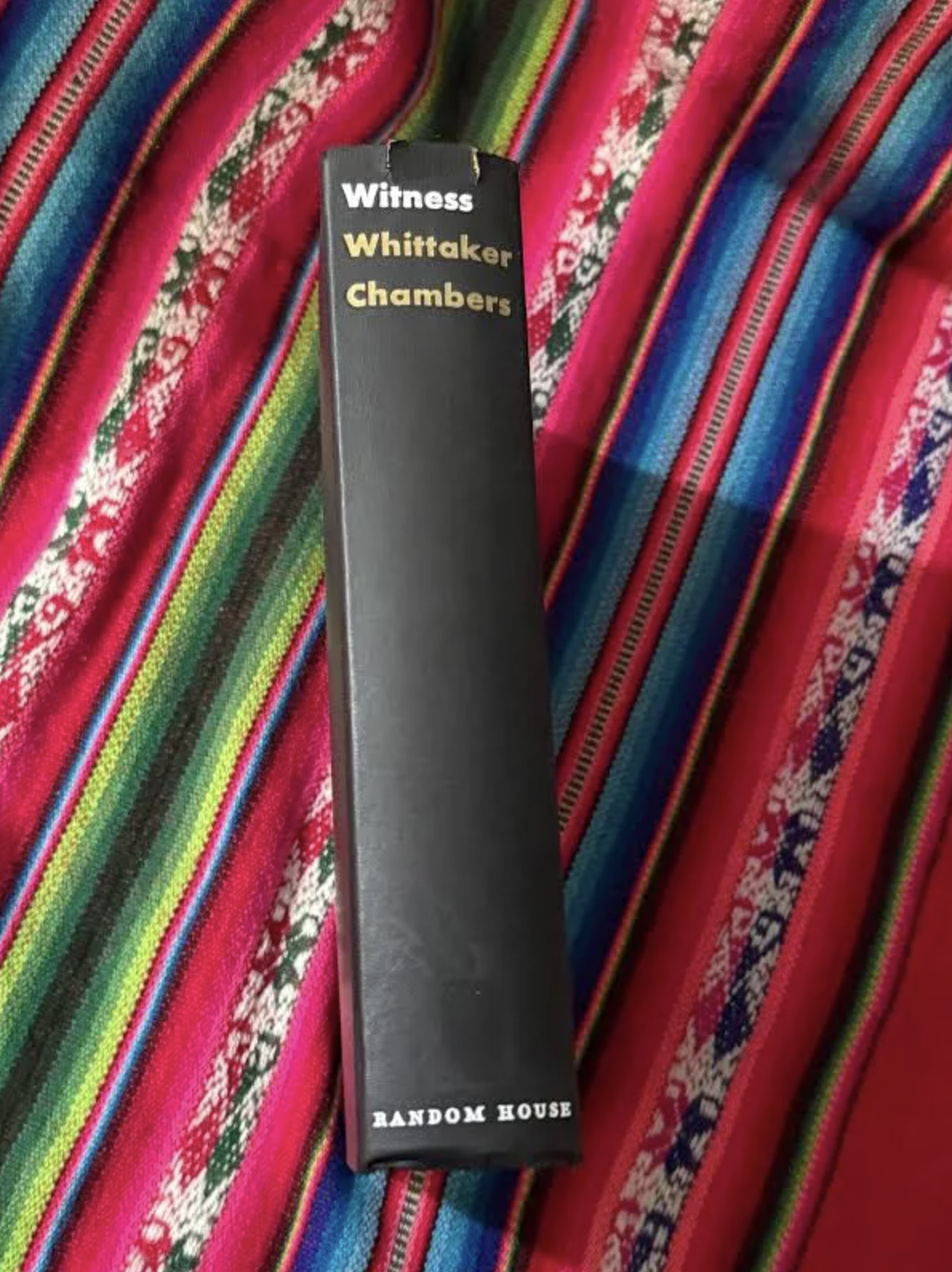
Witness — Whittaker Chambers
Whittaker Chambers
Random House, New York · 1952
First Edition · First Printing
The Book: First edition, first printing of Whittaker Chambers’s Witness. The copyright page explicitly states “First Printing,” with the correct 1952 Random House publication information, H. Wolff printer statement, and Jerome Kuhl design credit. Original black publisher’s cloth binding retained. No Book Club Edition indicators observed. This copy is without dust jacket.
Condition: Near Fine. Original black publisher’s cloth remains clean and square with light shelf wear, bright spine lettering, and a sound binding. Interior remains clean and structurally sound. No dust jacket present.
Story Of The Book
Whittaker Chambers understood that ideas could demand absolute loyalty—and exact devastating personal costs.
In Witness, Chambers recounts his journey from committed Communist underground operative to one of the central witnesses in the Alger Hiss espionage case. What begins as political autobiography becomes something broader: an account of ideological conviction, betrayal, conscience, faith, and the moral consequences of breaking with a system to which one had once given oneself completely.
Published in 1952, the book transformed Chambers’s public testimony into one of the defining political memoirs of the early Cold War. More than an account of Soviet espionage, Witness became a sweeping meditation on the conflict between individual conscience and totalizing political belief. Its publication also profoundly influenced postwar conservative thought, helping establish Chambers as one of the intellectual figures who shaped the emerging modern American conservative movement.
The enduring power of the book lies partly in its refusal to present ideology as something abstract. Chambers writes about belief as something that reorganizes friendships, loyalties, identity, and moral judgment—and about dissent as something that can require the repudiation of one’s own former life.
Why It’s In The Collection
Witness belongs in the collection because it documents one of the most difficult forms of dissent: the decision to turn against a movement one once believed in completely.
Chambers was not an outside critic of Communism. He had participated in the underground world he later exposed. His testimony therefore represents political defection in its most consequential form—the moment when loyalty to an ideology collides with personal conscience.
That makes Witness especially important within the collection’s anti-totalitarian holdings. The book argues, through lived experience, that systems demanding absolute ideological loyalty eventually place themselves in conflict with individual moral judgment. Chambers’s break with Communism transformed private disillusionment into public testimony, and that testimony became part of one of the defining political controversies of the Cold War.
This first printing preserves the publication event through which that testimony became a lasting intellectual and political document—one that influenced conservative thought while also standing more broadly as a record of conscience in revolt against ideological totalitarianism.
Collection Categories: Anti-Totalitarianism · Conservative Intellectual History · Memoir & Testimony · Political History
Whittaker Chambers
Random House, New York · 1952
First Edition · First Printing
The Book: First edition, first printing of Whittaker Chambers’s Witness. The copyright page explicitly states “First Printing,” with the correct 1952 Random House publication information, H. Wolff printer statement, and Jerome Kuhl design credit. Original black publisher’s cloth binding retained. No Book Club Edition indicators observed. This copy is without dust jacket.
Condition: Near Fine. Original black publisher’s cloth remains clean and square with light shelf wear, bright spine lettering, and a sound binding. Interior remains clean and structurally sound. No dust jacket present.
Story Of The Book
Whittaker Chambers understood that ideas could demand absolute loyalty—and exact devastating personal costs.
In Witness, Chambers recounts his journey from committed Communist underground operative to one of the central witnesses in the Alger Hiss espionage case. What begins as political autobiography becomes something broader: an account of ideological conviction, betrayal, conscience, faith, and the moral consequences of breaking with a system to which one had once given oneself completely.
Published in 1952, the book transformed Chambers’s public testimony into one of the defining political memoirs of the early Cold War. More than an account of Soviet espionage, Witness became a sweeping meditation on the conflict between individual conscience and totalizing political belief. Its publication also profoundly influenced postwar conservative thought, helping establish Chambers as one of the intellectual figures who shaped the emerging modern American conservative movement.
The enduring power of the book lies partly in its refusal to present ideology as something abstract. Chambers writes about belief as something that reorganizes friendships, loyalties, identity, and moral judgment—and about dissent as something that can require the repudiation of one’s own former life.
Why It’s In The Collection
Witness belongs in the collection because it documents one of the most difficult forms of dissent: the decision to turn against a movement one once believed in completely.
Chambers was not an outside critic of Communism. He had participated in the underground world he later exposed. His testimony therefore represents political defection in its most consequential form—the moment when loyalty to an ideology collides with personal conscience.
That makes Witness especially important within the collection’s anti-totalitarian holdings. The book argues, through lived experience, that systems demanding absolute ideological loyalty eventually place themselves in conflict with individual moral judgment. Chambers’s break with Communism transformed private disillusionment into public testimony, and that testimony became part of one of the defining political controversies of the Cold War.
This first printing preserves the publication event through which that testimony became a lasting intellectual and political document—one that influenced conservative thought while also standing more broadly as a record of conscience in revolt against ideological totalitarianism.
Collection Categories: Anti-Totalitarianism · Conservative Intellectual History · Memoir & Testimony · Political History