The Unmaking of a Mayor — William F. Buckley Jr.
William F. Buckley Jr.
The Viking Press, New York · 1966
First Edition · First Printing
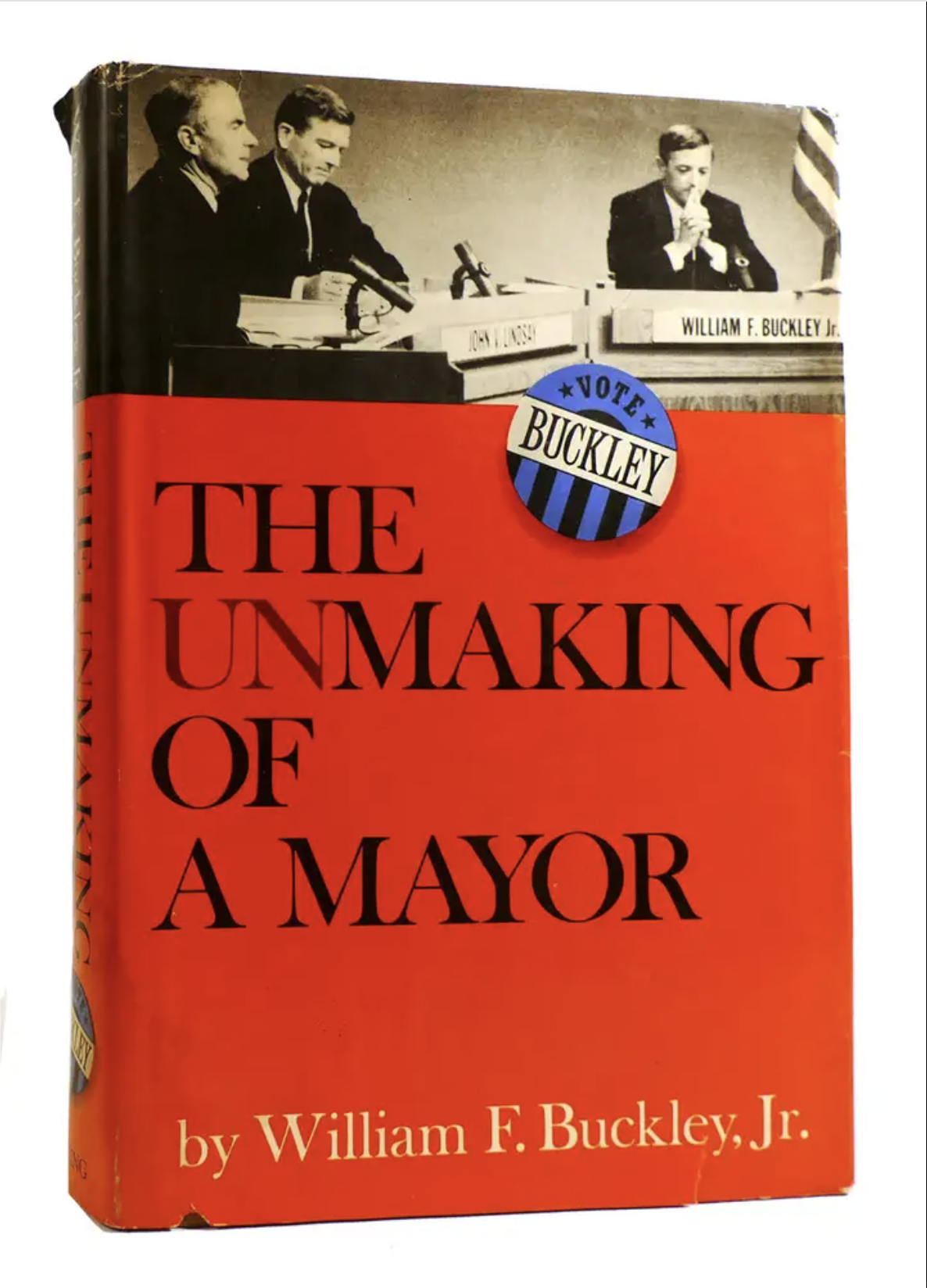
The Book: First edition, first printing of William F. Buckley Jr.’s The Unmaking of a Mayor. The copyright page states “First published in 1966 by The Viking Press, Inc.,” with no additional printing statement, consistent with the first printing. Original black publisher’s cloth in the original unclipped dust jacket retaining the $6.95 price. The volume was also cataloged and sold as a first edition by Between the Covers Rare Books (ABAA). No evidence of book-club manufacture, remainder marking, or rebinding observed.
Condition: Very Good book in Very Good dust jacket. The jacket shows light edge wear, minor spine sunning, and a few small closed tears. The book has light foxing to the page edges and a few internal ink notations, while retaining its original publisher’s binding and remaining structurally sound.
Story Of The Book
William F. Buckley Jr. spent years criticizing American politics from outside the electoral system. In 1965, he decided to enter it himself.
The Unmaking of a Mayor is Buckley’s firsthand account of his campaign for mayor of New York City. Published the following year, the book documents the moment when one of postwar America’s most prominent conservative intellectuals moved from political commentary into direct political participation.
The campaign allowed Buckley to test his ideas not merely as arguments on the page, but within the practical realities of electoral politics, urban governance, party competition, and public persuasion. In that sense, the book records a significant transition in his public life: the critic became the candidate.
Rather than simply observing political institutions and judging their failures from a distance, Buckley placed himself inside the machinery he had spent years scrutinizing. The Unmaking of a Mayor preserves that experiment in political participation from Buckley’s own perspective, making it both a campaign narrative and a record of conservative dissent moving from intellectual argument into electoral action.
Why It’s In The Collection
The Unmaking of a Mayor completes an important progression within The Buckley Dissent Set.
God and Man at Yale preserves Buckley challenging an academic institution. Rumbles Left and Right captures him contesting ideas and personalities across the broader political landscape. The Unmaking of a Mayor records the next step: dissent becoming direct political participation.
That progression matters to the collection because dissent is not confined to writing against institutions from the outside. It can also mean entering those institutions, submitting ideas to public judgment, and attempting to translate criticism into political action.
This first printing therefore preserves a distinct stage in Buckley’s career and in the collection’s broader treatment of conservative intellectual dissent. It documents the point at which a writer best known for challenging ideological and institutional orthodoxies chose to test those convictions in the electoral arena itself.
Collection Categories: Conservative Intellectual History · Political Dissent · Political History · Free Expression
William F. Buckley Jr.
The Viking Press, New York · 1966
First Edition · First Printing
The Book: First edition, first printing of William F. Buckley Jr.’s The Unmaking of a Mayor. The copyright page states “First published in 1966 by The Viking Press, Inc.,” with no additional printing statement, consistent with the first printing. Original black publisher’s cloth in the original unclipped dust jacket retaining the $6.95 price. The volume was also cataloged and sold as a first edition by Between the Covers Rare Books (ABAA). No evidence of book-club manufacture, remainder marking, or rebinding observed.
Condition: Very Good book in Very Good dust jacket. The jacket shows light edge wear, minor spine sunning, and a few small closed tears. The book has light foxing to the page edges and a few internal ink notations, while retaining its original publisher’s binding and remaining structurally sound.
Story Of The Book
William F. Buckley Jr. spent years criticizing American politics from outside the electoral system. In 1965, he decided to enter it himself.
The Unmaking of a Mayor is Buckley’s firsthand account of his campaign for mayor of New York City. Published the following year, the book documents the moment when one of postwar America’s most prominent conservative intellectuals moved from political commentary into direct political participation.
The campaign allowed Buckley to test his ideas not merely as arguments on the page, but within the practical realities of electoral politics, urban governance, party competition, and public persuasion. In that sense, the book records a significant transition in his public life: the critic became the candidate.
Rather than simply observing political institutions and judging their failures from a distance, Buckley placed himself inside the machinery he had spent years scrutinizing. The Unmaking of a Mayor preserves that experiment in political participation from Buckley’s own perspective, making it both a campaign narrative and a record of conservative dissent moving from intellectual argument into electoral action.
Why It’s In The Collection
The Unmaking of a Mayor completes an important progression within The Buckley Dissent Set.
God and Man at Yale preserves Buckley challenging an academic institution. Rumbles Left and Right captures him contesting ideas and personalities across the broader political landscape. The Unmaking of a Mayor records the next step: dissent becoming direct political participation.
That progression matters to the collection because dissent is not confined to writing against institutions from the outside. It can also mean entering those institutions, submitting ideas to public judgment, and attempting to translate criticism into political action.
This first printing therefore preserves a distinct stage in Buckley’s career and in the collection’s broader treatment of conservative intellectual dissent. It documents the point at which a writer best known for challenging ideological and institutional orthodoxies chose to test those convictions in the electoral arena itself.
Collection Categories: Conservative Intellectual History · Political Dissent · Political History · Free Expression