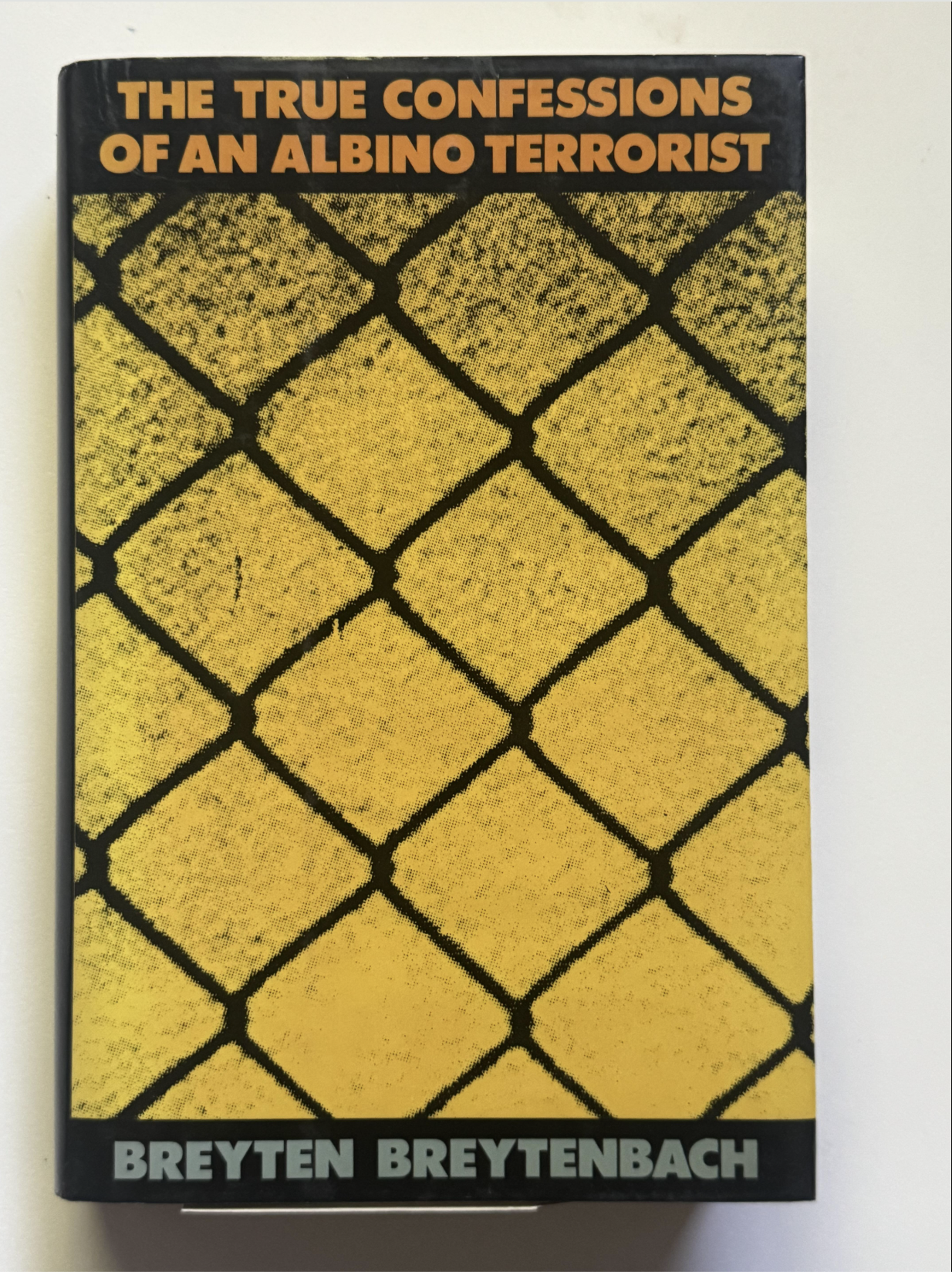
The True Confessions of an Albino Terrorist — Breyten Breytenbach
Breyten Breytenbach
Farrar, Straus and Giroux, New York · 1985
First American Edition · First Printing
The Book: First American edition, first printing of Breyten Breytenbach’s The True Confessions of an Albino Terrorist. The copyright page explicitly states “First American printing, 1985.” Original black cloth spine over black paper-covered boards in the original unclipped first-state dust jacket. No evidence of book-club manufacture, remainder marking, rebinding, ex-library provenance, or facsimile components.
Condition: Near Fine book in Near Fine dust jacket. The original jacket exhibits only light age toning and minimal handling wear. The book remains exceptionally clean with a tight binding, bright gilt spine lettering, and no ownership markings, foxing, structural defects, or restoration observed.
Story Of The Book
Breyten Breytenbach entered prison as a poet and emerged determined to expose the machinery of apartheid from within.
A South African writer and opponent of apartheid, Breytenbach was imprisoned by the apartheid government. The True Confessions of an Albino Terrorist transforms that experience into a literary examination of political imprisonment, interrogation, isolation, identity, and state repression.
Rather than describing apartheid solely through its laws or public institutions, Breytenbach writes from inside its machinery of coercion. His account explores what happens when authoritarian power acquires physical control over an individual and attempts to extend that control inward—over memory, identity, language, and the prisoner's understanding of himself.
The result combines firsthand testimony with literary reflection. Breytenbach does not portray resistance as uncomplicated heroism. He records its loneliness, uncertainty, fear, and moral complexity, revealing political imprisonment as an attempt not merely to confine the body but to destabilize the individual contained within it.
Published in the United States in 1985, during apartheid's final decade, this first American edition brought Breytenbach's testimony to American readers while the system he condemned remained in power.
Why It’s In The Collection
The True Confessions of an Albino Terrorist represents one of the collection’s most important forms of historical evidence: testimony produced by someone who personally experienced the exercise of authoritarian power.
Breytenbach does not reconstruct political imprisonment through government documents or later historical research. He describes what imprisonment, interrogation, and repression actually did to the individual subjected to them. That makes the book an important example of witness literature—an account capable of restoring human experience to systems of oppression that can otherwise be understood only through laws, institutions, and statistics.
The first American edition also preserves the international transmission of that testimony. Published while apartheid remained in force, it carried the account of an imprisoned South African dissident into the United States at a moment when international opposition to the regime was intensifying.
Within the collection, the book therefore documents both political imprisonment and the act of bearing witness afterward. Authoritarian power temporarily controlled Breytenbach’s physical freedom. Publication gave him the opportunity to describe that power publicly, permanently, and beyond the borders of the government that had imprisoned him.
Collection Categories: Anti-Apartheid · Witness Literature · Political Prisoners · Anti-Authoritarianism · Human Rights · Free Expression
Breyten Breytenbach
Farrar, Straus and Giroux, New York · 1985
First American Edition · First Printing
The Book: First American edition, first printing of Breyten Breytenbach’s The True Confessions of an Albino Terrorist. The copyright page explicitly states “First American printing, 1985.” Original black cloth spine over black paper-covered boards in the original unclipped first-state dust jacket. No evidence of book-club manufacture, remainder marking, rebinding, ex-library provenance, or facsimile components.
Condition: Near Fine book in Near Fine dust jacket. The original jacket exhibits only light age toning and minimal handling wear. The book remains exceptionally clean with a tight binding, bright gilt spine lettering, and no ownership markings, foxing, structural defects, or restoration observed.
Story Of The Book
Breyten Breytenbach entered prison as a poet and emerged determined to expose the machinery of apartheid from within.
A South African writer and opponent of apartheid, Breytenbach was imprisoned by the apartheid government. The True Confessions of an Albino Terrorist transforms that experience into a literary examination of political imprisonment, interrogation, isolation, identity, and state repression.
Rather than describing apartheid solely through its laws or public institutions, Breytenbach writes from inside its machinery of coercion. His account explores what happens when authoritarian power acquires physical control over an individual and attempts to extend that control inward—over memory, identity, language, and the prisoner's understanding of himself.
The result combines firsthand testimony with literary reflection. Breytenbach does not portray resistance as uncomplicated heroism. He records its loneliness, uncertainty, fear, and moral complexity, revealing political imprisonment as an attempt not merely to confine the body but to destabilize the individual contained within it.
Published in the United States in 1985, during apartheid's final decade, this first American edition brought Breytenbach's testimony to American readers while the system he condemned remained in power.
Why It’s In The Collection
The True Confessions of an Albino Terrorist represents one of the collection’s most important forms of historical evidence: testimony produced by someone who personally experienced the exercise of authoritarian power.
Breytenbach does not reconstruct political imprisonment through government documents or later historical research. He describes what imprisonment, interrogation, and repression actually did to the individual subjected to them. That makes the book an important example of witness literature—an account capable of restoring human experience to systems of oppression that can otherwise be understood only through laws, institutions, and statistics.
The first American edition also preserves the international transmission of that testimony. Published while apartheid remained in force, it carried the account of an imprisoned South African dissident into the United States at a moment when international opposition to the regime was intensifying.
Within the collection, the book therefore documents both political imprisonment and the act of bearing witness afterward. Authoritarian power temporarily controlled Breytenbach’s physical freedom. Publication gave him the opportunity to describe that power publicly, permanently, and beyond the borders of the government that had imprisoned him.
Collection Categories: Anti-Apartheid · Witness Literature · Political Prisoners · Anti-Authoritarianism · Human Rights · Free Expression