The Rebel — Albert Camus
Full Title: The Rebel: An Essay on Man in Revolt
Albert Camus
Alfred A. Knopf, New York · 1954
First American Edition · First Printing
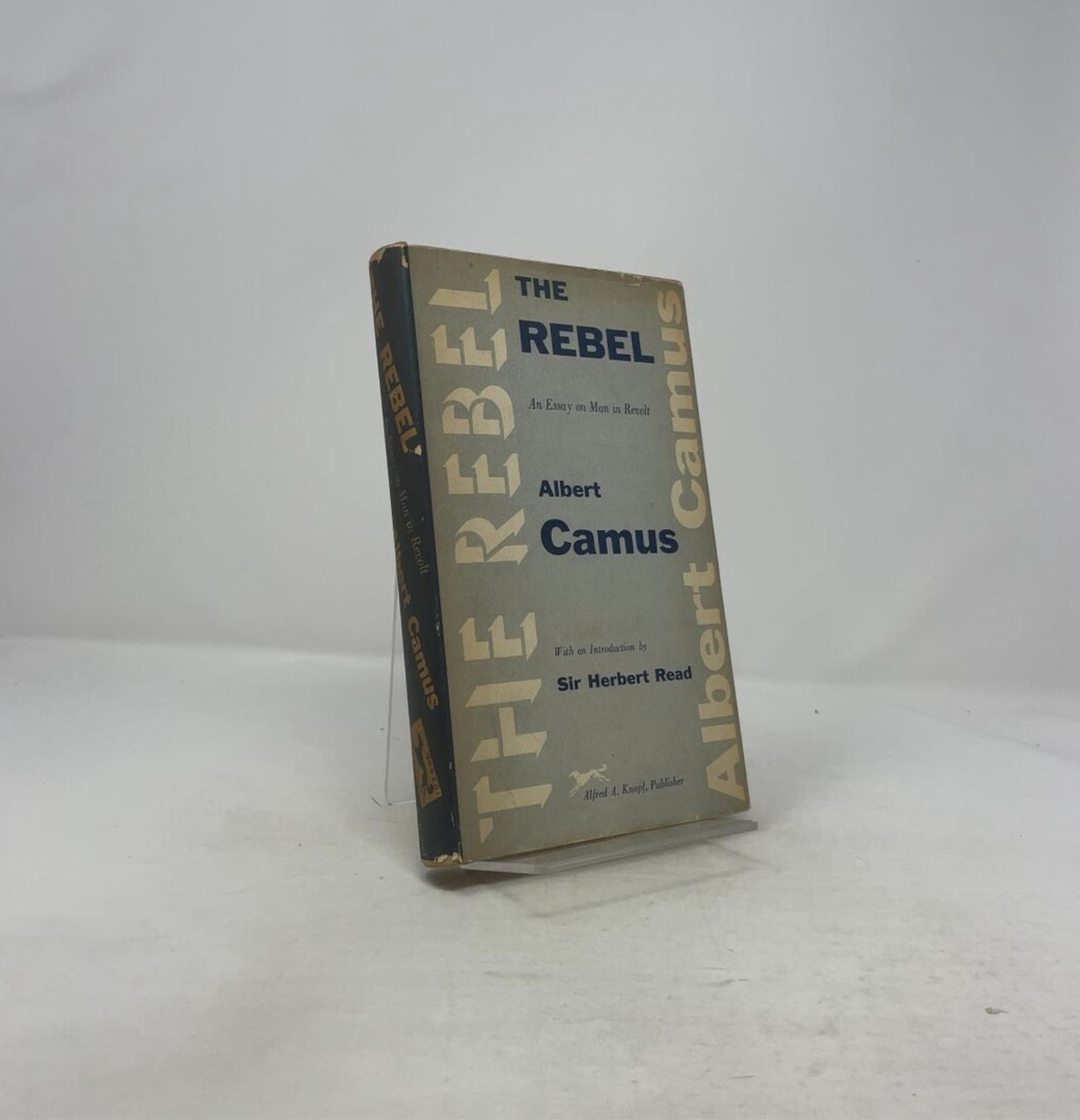
The Book: First American edition, first printing of Albert Camus’s The Rebel: An Essay on Man in Revolt, translated from the French L’Homme Révolté by Anthony Bower. The copyright/printing page records printing by Unwin Brothers Limited in Great Britain and contains no later-printing statement, consistent with Knopf’s first-printing practice for this edition. Original publisher’s cloth in the original Alfred A. Knopf Borzoi dust jacket retaining the $4.00 net price. All observed bibliographic characteristics are consistent with the first American edition, first printing.
Condition: Near Fine- book in Very Good- dust jacket. The jacket exhibits moderate edge wear, rubbing, light toning, and small chips at the spine ends. The book remains clean and structurally sound with mild, even age toning.
Story Of The Book
Albert Camus asked a dangerous question: when does rebellion against injustice become another form of tyranny?
Published in French as L’Homme Révolté, The Rebel is Camus’s sustained examination of revolt, revolution, political violence, and the moral limits of ideology. Rather than rejecting rebellion, Camus begins from its necessity. Human beings confronted by humiliation, oppression, or arbitrary authority eventually say no. That refusal can affirm dignity and solidarity.
The danger begins when revolt abandons those limits.
Camus traces how revolutionary movements can transform the defense of human freedom into ideological systems willing to justify murder, terror, and repression in the name of a supposedly inevitable future. His target is political absolutism: the belief that history, ideology, or revolutionary necessity can make human beings expendable.
The book also became a major intellectual event in postwar Europe. Camus’s rejection of revolutionary violence and ideological absolutism placed him in direct conflict with intellectuals more sympathetic to Marxist revolutionary politics, most famously contributing to his celebrated break with Jean-Paul Sartre.
Why It’s In The Collection
The Rebel belongs near the philosophical center of the collection because it asks whether resistance to power can itself become authoritarian.
Camus refuses the easy moral division in which rebels are inherently virtuous and established authorities inherently corrupt. He insists that dissent retains its moral legitimacy only so long as it continues to recognize limits—especially the value of individual human life. Once a political movement accepts that people may be sacrificed to an abstract historical purpose, rebellion can reproduce the very domination it originally opposed.
That makes The Rebel unusually important to a collection concerned with anti-authoritarianism. It does not merely condemn authoritarian governments. It challenges the ideological logic by which movements opposing those governments can rationalize coercion, terror, and dehumanization of their own.
This first American edition is also historically significant because it represents the work’s first English-language publication, carrying Camus’s critique of revolutionary violence, ideological absolutism, and totalitarianism into the American intellectual world.
Collection Categories: Anti-Totalitarianism · Anti-Authoritarianism · Literature
Full Title: The Rebel: An Essay on Man in Revolt
Albert Camus
Alfred A. Knopf, New York · 1954
First American Edition · First Printing
The Book: First American edition, first printing of Albert Camus’s The Rebel: An Essay on Man in Revolt, translated from the French L’Homme Révolté by Anthony Bower. The copyright/printing page records printing by Unwin Brothers Limited in Great Britain and contains no later-printing statement, consistent with Knopf’s first-printing practice for this edition. Original publisher’s cloth in the original Alfred A. Knopf Borzoi dust jacket retaining the $4.00 net price. All observed bibliographic characteristics are consistent with the first American edition, first printing.
Condition: Near Fine- book in Very Good- dust jacket. The jacket exhibits moderate edge wear, rubbing, light toning, and small chips at the spine ends. The book remains clean and structurally sound with mild, even age toning.
Story Of The Book
Albert Camus asked a dangerous question: when does rebellion against injustice become another form of tyranny?
Published in French as L’Homme Révolté, The Rebel is Camus’s sustained examination of revolt, revolution, political violence, and the moral limits of ideology. Rather than rejecting rebellion, Camus begins from its necessity. Human beings confronted by humiliation, oppression, or arbitrary authority eventually say no. That refusal can affirm dignity and solidarity.
The danger begins when revolt abandons those limits.
Camus traces how revolutionary movements can transform the defense of human freedom into ideological systems willing to justify murder, terror, and repression in the name of a supposedly inevitable future. His target is political absolutism: the belief that history, ideology, or revolutionary necessity can make human beings expendable.
The book also became a major intellectual event in postwar Europe. Camus’s rejection of revolutionary violence and ideological absolutism placed him in direct conflict with intellectuals more sympathetic to Marxist revolutionary politics, most famously contributing to his celebrated break with Jean-Paul Sartre.
Why It’s In The Collection
The Rebel belongs near the philosophical center of the collection because it asks whether resistance to power can itself become authoritarian.
Camus refuses the easy moral division in which rebels are inherently virtuous and established authorities inherently corrupt. He insists that dissent retains its moral legitimacy only so long as it continues to recognize limits—especially the value of individual human life. Once a political movement accepts that people may be sacrificed to an abstract historical purpose, rebellion can reproduce the very domination it originally opposed.
That makes The Rebel unusually important to a collection concerned with anti-authoritarianism. It does not merely condemn authoritarian governments. It challenges the ideological logic by which movements opposing those governments can rationalize coercion, terror, and dehumanization of their own.
This first American edition is also historically significant because it represents the work’s first English-language publication, carrying Camus’s critique of revolutionary violence, ideological absolutism, and totalitarianism into the American intellectual world.
Collection Categories: Anti-Totalitarianism · Anti-Authoritarianism · Literature