The Herblock Book — Herbert "Herblock" Block
Herbert “Herblock” Block
The Beacon Press, Boston · 1952
First Edition · First Printing · Signed & Inscribed
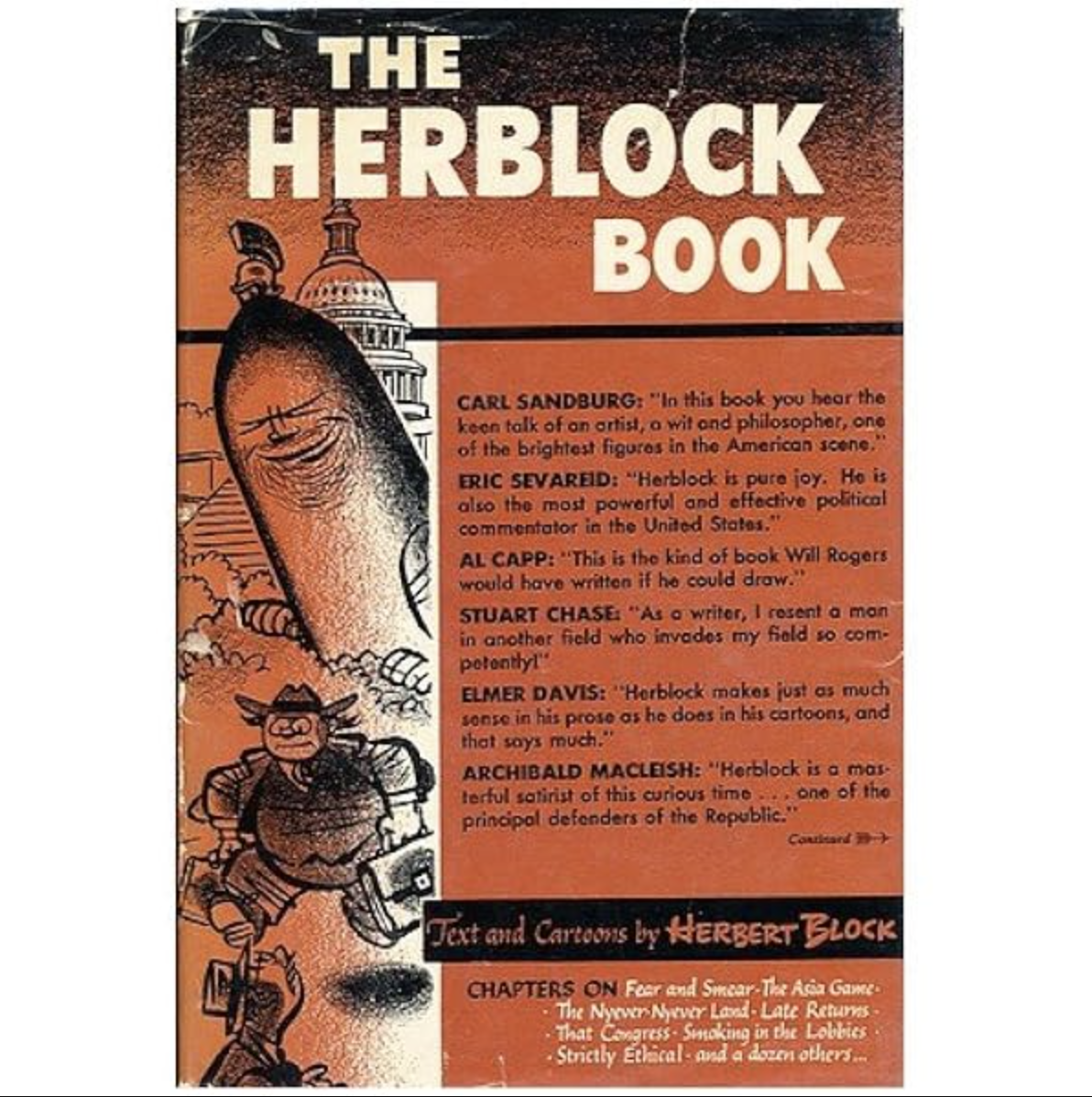
The Book: True first edition, first printing of The Herblock Book, collecting Herbert Block’s political cartoons and commentary during the early Cold War. Original orange publisher’s cloth in the original unclipped pictorial dust jacket. This copy is additionally distinguished by a contemporary presentation inscription from Herblock on the front free endpaper: “For Alice, with all best wishes from a fellow-member of the editorial staff — Herb Block.” The correct Beacon Press title page, publisher’s binding, and first-issue jacket are present, with no evidence of book-club manufacture or later reprint characteristics.
Condition: Very Good book in Fair dust jacket. The book remains square and sound with a clean interior, light even age toning, and bright spine lettering. The original jacket exhibits extensive edge wear, tears and splits, substantial chipping and paper loss at the spine ends and corners, soiling, age toning, and historic transparent-tape reinforcement to the spine and rear panel, while retaining its principal front-panel design and typography.
Story Of The Book
Sometimes a cartoon can accomplish what a thousand editorials cannot.
By the time The Herblock Book appeared in 1952, Herbert Block had become one of America’s most influential editorial cartoonists. Working in an era defined by the early Cold War, anti-communist fear, political conformity, and the rise of Senator Joseph McCarthy, Herblock used the deceptively accessible form of the newspaper cartoon to subject political power to relentless public scrutiny.
His drawings attacked demagoguery, corruption, authoritarianism, and political hypocrisy while reaching an audience of millions through the daily press. Most famously, Herblock helped popularize the term “McCarthyism,” turning a senator’s name into a permanent description of political accusation pursued through fear, intimidation, and insufficient evidence.
The Herblock Book transformed work created for the inherently temporary medium of newspapers into a permanent printed record. Cartoons designed to respond to yesterday’s political events could now be encountered together, revealing something larger than any individual drawing: the emergence of political cartooning as a sustained form of democratic criticism.
Herblock’s drawings rarely changed policy by themselves. What they could change was how Americans saw power—and once an image entered the public imagination, politicians had considerably less control over how they were remembered.
Why It’s In The Collection
The Herblock Book expands the collection’s conception of dissent beyond speeches, manifestos, journalism, and literature. A drawing can challenge authority too.
Herblock demonstrated that free expression does not derive its political importance solely from the seriousness or length of an argument. Satire could compress criticism into a single image capable of circulating through millions of homes, confronting political figures in a medium they could neither easily control nor ignore.
This particular copy carries an additional significance because the object is directly connected to the person whose dissent it preserves. Herblock’s presentation inscription to “Alice,” whom he identifies as a “fellow-member of the editorial staff,” transforms an ordinary first printing into an association between the published record and the journalist who created it.
The result is both a publication-event object and an authorial artifact: a first printing preserving one of the twentieth century’s defining voices of American political satire, physically inscribed by the man who used that voice to challenge McCarthyism, political opportunism, and abuses of democratic power.
Collection Categories: Free Expression · Political Dissent · Political History · Investigative Journalism · Anti-Authoritarianism
Herbert “Herblock” Block
The Beacon Press, Boston · 1952
First Edition · First Printing · Signed & Inscribed
The Book: True first edition, first printing of The Herblock Book, collecting Herbert Block’s political cartoons and commentary during the early Cold War. Original orange publisher’s cloth in the original unclipped pictorial dust jacket. This copy is additionally distinguished by a contemporary presentation inscription from Herblock on the front free endpaper: “For Alice, with all best wishes from a fellow-member of the editorial staff — Herb Block.” The correct Beacon Press title page, publisher’s binding, and first-issue jacket are present, with no evidence of book-club manufacture or later reprint characteristics.
Condition: Very Good book in Fair dust jacket. The book remains square and sound with a clean interior, light even age toning, and bright spine lettering. The original jacket exhibits extensive edge wear, tears and splits, substantial chipping and paper loss at the spine ends and corners, soiling, age toning, and historic transparent-tape reinforcement to the spine and rear panel, while retaining its principal front-panel design and typography.
Story Of The Book
Sometimes a cartoon can accomplish what a thousand editorials cannot.
By the time The Herblock Book appeared in 1952, Herbert Block had become one of America’s most influential editorial cartoonists. Working in an era defined by the early Cold War, anti-communist fear, political conformity, and the rise of Senator Joseph McCarthy, Herblock used the deceptively accessible form of the newspaper cartoon to subject political power to relentless public scrutiny.
His drawings attacked demagoguery, corruption, authoritarianism, and political hypocrisy while reaching an audience of millions through the daily press. Most famously, Herblock helped popularize the term “McCarthyism,” turning a senator’s name into a permanent description of political accusation pursued through fear, intimidation, and insufficient evidence.
The Herblock Book transformed work created for the inherently temporary medium of newspapers into a permanent printed record. Cartoons designed to respond to yesterday’s political events could now be encountered together, revealing something larger than any individual drawing: the emergence of political cartooning as a sustained form of democratic criticism.
Herblock’s drawings rarely changed policy by themselves. What they could change was how Americans saw power—and once an image entered the public imagination, politicians had considerably less control over how they were remembered.
Why It’s In The Collection
The Herblock Book expands the collection’s conception of dissent beyond speeches, manifestos, journalism, and literature. A drawing can challenge authority too.
Herblock demonstrated that free expression does not derive its political importance solely from the seriousness or length of an argument. Satire could compress criticism into a single image capable of circulating through millions of homes, confronting political figures in a medium they could neither easily control nor ignore.
This particular copy carries an additional significance because the object is directly connected to the person whose dissent it preserves. Herblock’s presentation inscription to “Alice,” whom he identifies as a “fellow-member of the editorial staff,” transforms an ordinary first printing into an association between the published record and the journalist who created it.
The result is both a publication-event object and an authorial artifact: a first printing preserving one of the twentieth century’s defining voices of American political satire, physically inscribed by the man who used that voice to challenge McCarthyism, political opportunism, and abuses of democratic power.
Collection Categories: Free Expression · Political Dissent · Political History · Investigative Journalism · Anti-Authoritarianism