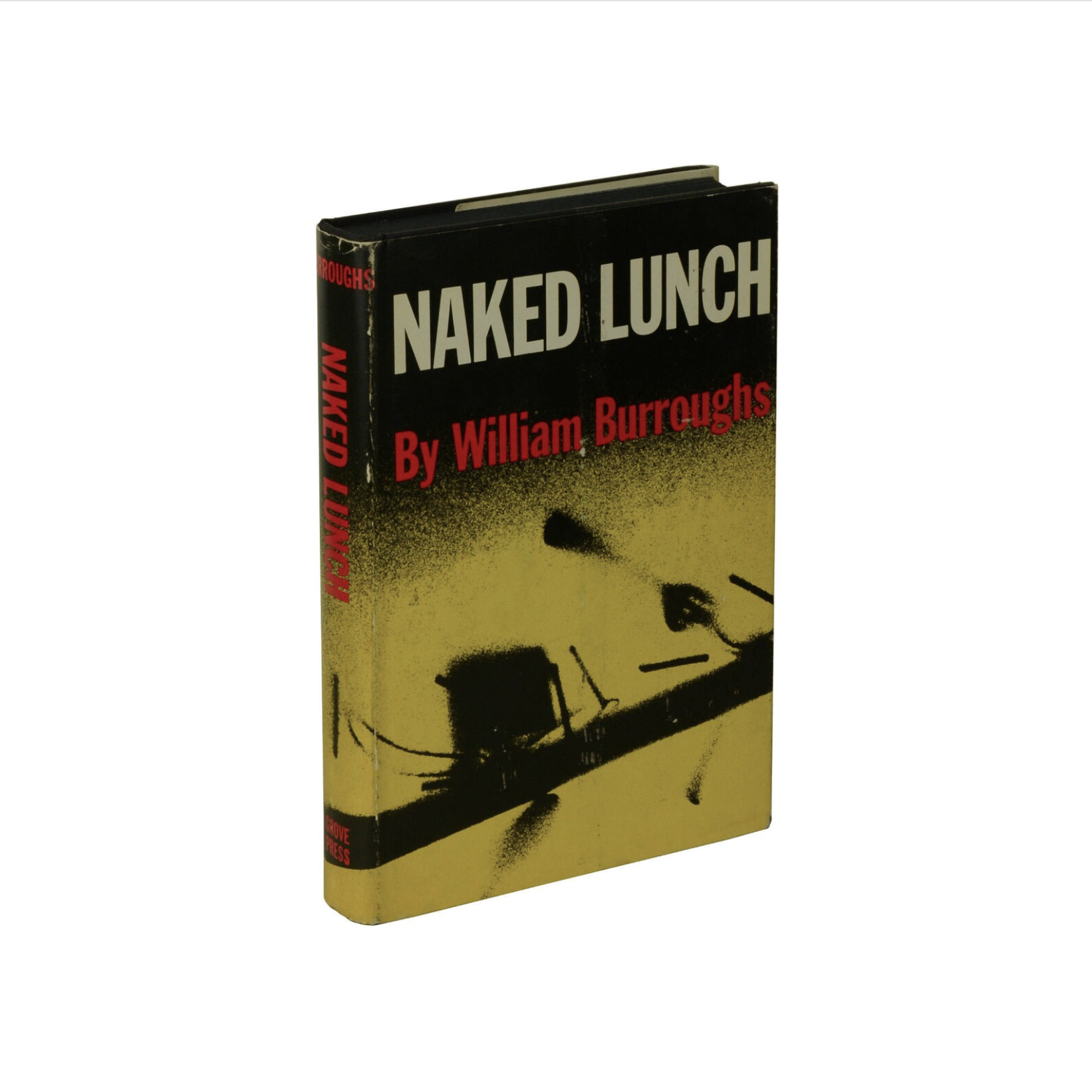
Naked Lunch — William S. Burroughs
William S. Burroughs
Grove Press, New York · 1962
First American Edition · Third Printing
The Book: First American edition, third printing of William S. Burroughs’s Naked Lunch. The Grove Press title page confirms the First American Edition, and the copyright page explicitly states “Third printing.” Original publisher’s cloth-backed boards in the original unclipped Grove Press dust jacket. The jacket retains contemporary endorsements by Norman Mailer, Robert Lowell, E. S. Seldon, and Jack Kerouac, consistent with early Grove printings. No evidence of rebinding, facsimile jacket, or replacement components observed.
Condition: Very Good book in Near Fine dust jacket. The original jacket exhibits moderate edge wear, chipping, and loss at the spine extremities. The original publisher’s cloth-backed boards remain present throughout, with no evidence of replacement components or restoration noted in the collection record.
Story Of The Book
William S. Burroughs rejected the idea that literature had to remain respectable.
Through fragmented narrative, surreal imagery, obscenity, satire, and relentless social criticism, Naked Lunch challenged prevailing ideas about literary form and public morality unlike almost any American novel of its era. Its publication quickly became inseparable from the question of whether the state had the authority to suppress a work because of its sexual content, language, and perceived offensiveness.
The American publication history became a major censorship battle. Grove Press continued to publish and defend the book against obscenity challenges, while writers and critics publicly argued for its literary legitimacy. The controversy ultimately helped transform Naked Lunch from a notorious underground novel into one of the defining works in the history of modern literary freedom.
This third printing belongs to that active censorship era. It was not issued after the legal and cultural struggle had become settled history. It circulated while the controversy surrounding the book was still shaping how American law and culture understood the boundary between obscenity and protected literary expression.
Why It’s In The Collection
Naked Lunch is one of the clearest examples in the collection of a book whose publication history became part of the work itself.
This copy was selected intentionally as an early censorship-era printing rather than simply as a later reading copy. By the time this third printing appeared, Grove Press was still defending the novel against obscenity accusations while simultaneously establishing its literary importance. The retained original dust jacket—with contemporary endorsements from major literary figures—became part of that defense, presenting the book to readers not merely as scandalous material but as serious literature worthy of protection.
That makes this copy especially valuable to a collection concerned with free expression, censorship, and the ability of publication to challenge legal and cultural boundaries. Rather than preserving only the beginning of the story, this printing preserves the struggle itself: the period in which Naked Lunch was still helping redefine the limits of artistic freedom in the United States.
Collection Categories: Free Expression · Censorship · Beat Generation · Anti-Authoritarianism · Literature
William S. Burroughs
Grove Press, New York · 1962
First American Edition · Third Printing
The Book: First American edition, third printing of William S. Burroughs’s Naked Lunch. The Grove Press title page confirms the First American Edition, and the copyright page explicitly states “Third printing.” Original publisher’s cloth-backed boards in the original unclipped Grove Press dust jacket. The jacket retains contemporary endorsements by Norman Mailer, Robert Lowell, E. S. Seldon, and Jack Kerouac, consistent with early Grove printings. No evidence of rebinding, facsimile jacket, or replacement components observed.
Condition: Very Good book in Near Fine dust jacket. The original jacket exhibits moderate edge wear, chipping, and loss at the spine extremities. The original publisher’s cloth-backed boards remain present throughout, with no evidence of replacement components or restoration noted in the collection record.
Story Of The Book
William S. Burroughs rejected the idea that literature had to remain respectable.
Through fragmented narrative, surreal imagery, obscenity, satire, and relentless social criticism, Naked Lunch challenged prevailing ideas about literary form and public morality unlike almost any American novel of its era. Its publication quickly became inseparable from the question of whether the state had the authority to suppress a work because of its sexual content, language, and perceived offensiveness.
The American publication history became a major censorship battle. Grove Press continued to publish and defend the book against obscenity challenges, while writers and critics publicly argued for its literary legitimacy. The controversy ultimately helped transform Naked Lunch from a notorious underground novel into one of the defining works in the history of modern literary freedom.
This third printing belongs to that active censorship era. It was not issued after the legal and cultural struggle had become settled history. It circulated while the controversy surrounding the book was still shaping how American law and culture understood the boundary between obscenity and protected literary expression.
Why It’s In The Collection
Naked Lunch is one of the clearest examples in the collection of a book whose publication history became part of the work itself.
This copy was selected intentionally as an early censorship-era printing rather than simply as a later reading copy. By the time this third printing appeared, Grove Press was still defending the novel against obscenity accusations while simultaneously establishing its literary importance. The retained original dust jacket—with contemporary endorsements from major literary figures—became part of that defense, presenting the book to readers not merely as scandalous material but as serious literature worthy of protection.
That makes this copy especially valuable to a collection concerned with free expression, censorship, and the ability of publication to challenge legal and cultural boundaries. Rather than preserving only the beginning of the story, this printing preserves the struggle itself: the period in which Naked Lunch was still helping redefine the limits of artistic freedom in the United States.
Collection Categories: Free Expression · Censorship · Beat Generation · Anti-Authoritarianism · Literature