Le Silence de la Mer — Vercors (Jean Bruller)
Vercors (Jean Bruller)
Les Cahiers du Silence, London · 1943
First London Edition · July 25, 1943 Printing
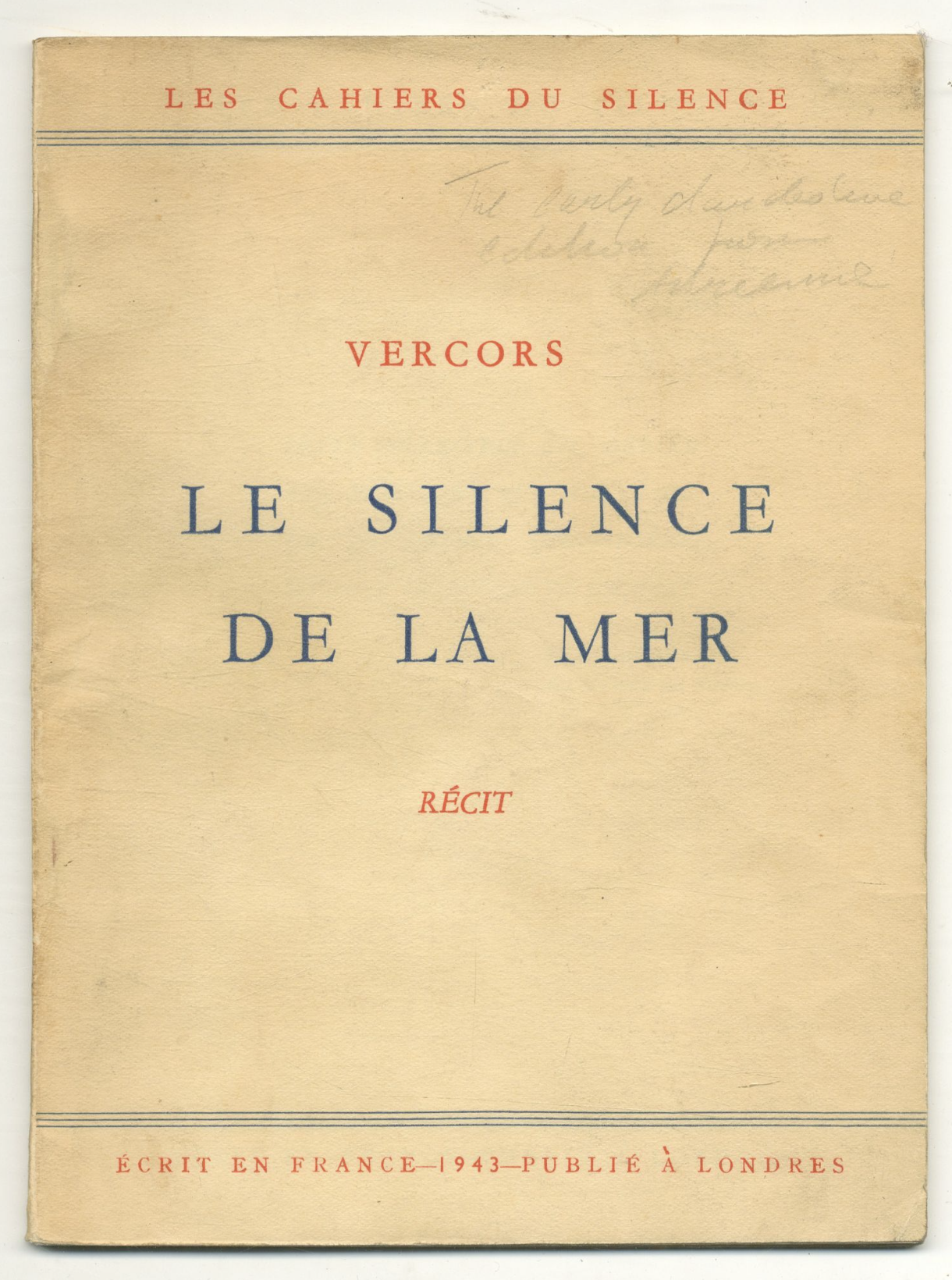
The Book: First London edition of Vercors’s Le Silence de la Mer, printed on July 25, 1943. The original printed wrappers bear the statement “Écrit en France – 1943 – Publié à Londres,” while the colophon records completion of printing on July 25, 1943. Issued by Les Cahiers du Silence as part of the wartime Free French publishing effort, this edition followed the original clandestine Paris publication and carried the work beyond occupied France into the Allied world. Original publisher’s printed wrappers retained with no evidence of facsimile production, modern rebinding, or replacement wrappers.
Condition: Very Good. Original wrappers exhibit moderate toning, scattered soiling, light creasing, minor edge wear, and localized splitting along the spine folds with small losses at the spine extremities. The interior remains notably bright and clean with minimal foxing or staining. No restoration observed.
Story Of The Book
When open resistance became impossible, silence itself became a language of defiance.
Written under the pseudonym Vercors by French artist and writer Jean Bruller, Le Silence de la Mer tells the story of a French man and his niece forced to accommodate a German officer in their home during the Nazi occupation. They cannot prevent his presence. They cannot remove him. Instead, they refuse to acknowledge him.
Their silence becomes resistance.
The work first appeared clandestinely in occupied Paris through the newly created Éditions de Minuit, whose underground publishing operation transformed literature itself into an act of opposition. Producing forbidden writing under occupation required secrecy and personal risk; the physical circulation of such a book challenged an occupying regime attempting to control not only territory, but French political and intellectual life.
This London edition represents the next stage of that resistance. Published on July 25, 1943 by Les Cahiers du Silence, it carried a work born in occupied France beyond the reach of Nazi censorship and into the Free French and Allied world. The words printed on its wrapper—“Écrit en France – 1943 – Publié à Londres”—make that journey part of the physical object itself.
Le Silence de la Mer ultimately became one of the defining literary symbols of French intellectual resistance: a story in which people denied conventional political power discover that even refusing to speak can become an assertion of moral independence.
Why It’s In The Collection
Le Silence de la Mer embodies the collection’s thesis unusually literally because the publication of the work was itself an act of resistance.
The book did not merely describe opposition to authoritarianism after the danger had passed. Its original clandestine publication emerged from occupied France, where independent expression existed under the threat of censorship and political repression. This wartime London edition then participated in the effort to preserve and disseminate that suppressed literature beyond the territory in which it had been created.
That makes the physical object inseparable from the ideas it contains. The story transforms silence into resistance; the publication transforms printing into resistance. Both demonstrate that authority does not require active obedience merely because it possesses overwhelming physical power.
This 1943 London printing therefore preserves more than a celebrated work of French literature. It preserves part of the wartime network through which writers and publishers refused to allow occupation to determine which French ideas would survive, making it an important publication-event object in the histories of free expression, underground publishing, intellectual resistance, and opposition to totalitarianism.
Collection Categories: French Resistance · Free Expression · Anti-Authoritarianism · Witness Literature · Underground Press
Vercors (Jean Bruller)
Les Cahiers du Silence, London · 1943
First London Edition · July 25, 1943 Printing
The Book: First London edition of Vercors’s Le Silence de la Mer, printed on July 25, 1943. The original printed wrappers bear the statement “Écrit en France – 1943 – Publié à Londres,” while the colophon records completion of printing on July 25, 1943. Issued by Les Cahiers du Silence as part of the wartime Free French publishing effort, this edition followed the original clandestine Paris publication and carried the work beyond occupied France into the Allied world. Original publisher’s printed wrappers retained with no evidence of facsimile production, modern rebinding, or replacement wrappers.
Condition: Very Good. Original wrappers exhibit moderate toning, scattered soiling, light creasing, minor edge wear, and localized splitting along the spine folds with small losses at the spine extremities. The interior remains notably bright and clean with minimal foxing or staining. No restoration observed.
Story Of The Book
When open resistance became impossible, silence itself became a language of defiance.
Written under the pseudonym Vercors by French artist and writer Jean Bruller, Le Silence de la Mer tells the story of a French man and his niece forced to accommodate a German officer in their home during the Nazi occupation. They cannot prevent his presence. They cannot remove him. Instead, they refuse to acknowledge him.
Their silence becomes resistance.
The work first appeared clandestinely in occupied Paris through the newly created Éditions de Minuit, whose underground publishing operation transformed literature itself into an act of opposition. Producing forbidden writing under occupation required secrecy and personal risk; the physical circulation of such a book challenged an occupying regime attempting to control not only territory, but French political and intellectual life.
This London edition represents the next stage of that resistance. Published on July 25, 1943 by Les Cahiers du Silence, it carried a work born in occupied France beyond the reach of Nazi censorship and into the Free French and Allied world. The words printed on its wrapper—“Écrit en France – 1943 – Publié à Londres”—make that journey part of the physical object itself.
Le Silence de la Mer ultimately became one of the defining literary symbols of French intellectual resistance: a story in which people denied conventional political power discover that even refusing to speak can become an assertion of moral independence.
Why It’s In The Collection
Le Silence de la Mer embodies the collection’s thesis unusually literally because the publication of the work was itself an act of resistance.
The book did not merely describe opposition to authoritarianism after the danger had passed. Its original clandestine publication emerged from occupied France, where independent expression existed under the threat of censorship and political repression. This wartime London edition then participated in the effort to preserve and disseminate that suppressed literature beyond the territory in which it had been created.
That makes the physical object inseparable from the ideas it contains. The story transforms silence into resistance; the publication transforms printing into resistance. Both demonstrate that authority does not require active obedience merely because it possesses overwhelming physical power.
This 1943 London printing therefore preserves more than a celebrated work of French literature. It preserves part of the wartime network through which writers and publishers refused to allow occupation to determine which French ideas would survive, making it an important publication-event object in the histories of free expression, underground publishing, intellectual resistance, and opposition to totalitarianism.
Collection Categories: French Resistance · Free Expression · Anti-Authoritarianism · Witness Literature · Underground Press