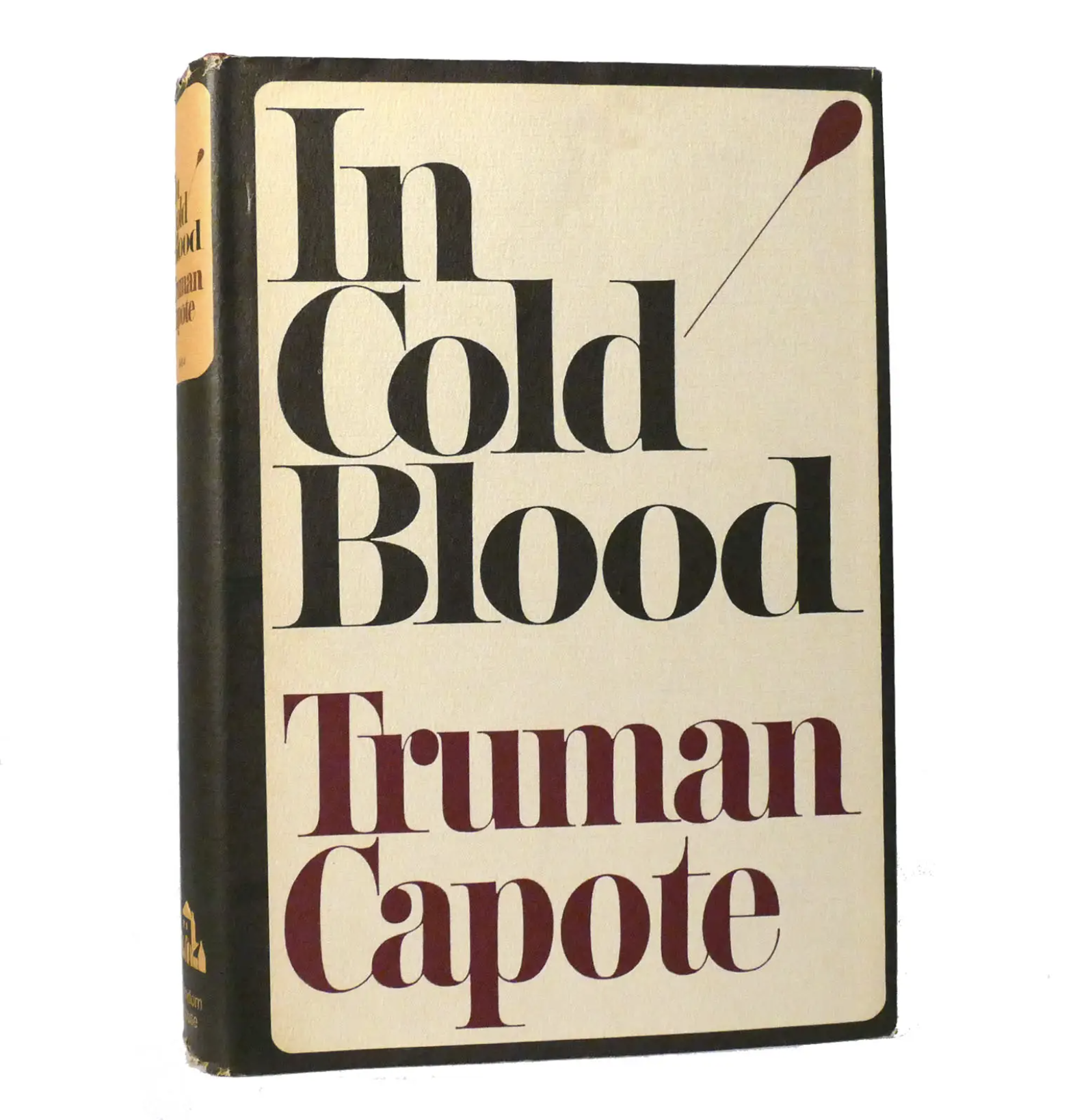
In Cold Blood — Truman Capote
Full Title: In Cold Blood: A True Account of a Multiple Murder and Its Consequences
Truman Capote
Random House, New York · 1965
First Edition · First Printing
The Book: First edition, first printing of Truman Capote’s In Cold Blood. The copyright page explicitly states “FIRST PRINTING.” Original maroon publisher’s cloth with gilt “TC” initials to the front board and silver-and-gilt spine lettering, in the original S. Neil Fujita dust jacket. The jacket retains the correct $5.95 price and 1/66 code on the front flap, with the correct first-state Random House wording on the rear flap. No visible book-club blind stamp appears on the rear board.
Condition: Near Fine book in Good+ first-state dust jacket. The jacket shows moderate edge wear, rubbing, spine-end chipping, several short closed tears, and minor losses while remaining structurally complete and highly presentable. The underlying book retains bright cloth, strong gilt, a tight binding, and a clean interior.
Story Of The Book
Four people were murdered in a Kansas farmhouse, but Truman Capote refused to let the story end with the bodies.
For years, Capote reconstructed the 1959 murders of the Clutter family through interviews, documentary research, and extensive reporting, undertaken with crucial assistance from Harper Lee. He followed not only the victims and the investigation, but also the lives of Perry Smith and Richard Hickock, the men ultimately convicted and executed for the crime.
What emerged was neither conventional journalism nor conventional fiction. Capote used techniques associated with the novel—scene, characterization, dialogue, narrative structure—to produce what he promoted as a “nonfiction novel.” The result transformed expectations of factual storytelling and became a landmark in the development of narrative nonfiction, true-crime writing, and literary journalism.
The book’s power also came from its refusal to keep victims and perpetrators in emotionally separate worlds. Capote reconstructed the crime with an intimacy that forced readers to confront violence not simply as something committed by unknowable monsters, but by recognizable human beings shaped by isolation, grievance, fantasy, circumstance, and choice.
Why It’s In The Collection
In Cold Blood belongs in the collection because it demonstrates how investigative reporting can transform documentary fact into a deeper form of public understanding.
Capote did not treat police reports, courtroom testimony, or newspaper coverage as sufficient explanations of the Clutter murders. He spent years reconstructing the crime and its participants in extraordinary detail, showing that factual truth could be expanded through sustained investigation and literary craft. In doing so, the book permanently altered the relationship between journalism, literature, and documentary narrative.
This first printing is therefore important as a publication-event object. It preserves the moment when one of the twentieth century’s defining experiments in nonfiction entered American publishing and helped establish a form that would influence generations of reporters, documentarians, and writers.
Within the collection, it also serves a broader purpose: restoring humanity to people whom public narratives often reduce to roles—victim, murderer, witness, defendant. In Cold Blood complicates those categories without excusing violence, forcing readers to look more closely at the human lives contained inside a criminal event.
Collection Categories: Investigative Journalism · True Crime · Literature
Full Title: In Cold Blood: A True Account of a Multiple Murder and Its Consequences
Truman Capote
Random House, New York · 1965
First Edition · First Printing
The Book: First edition, first printing of Truman Capote’s In Cold Blood. The copyright page explicitly states “FIRST PRINTING.” Original maroon publisher’s cloth with gilt “TC” initials to the front board and silver-and-gilt spine lettering, in the original S. Neil Fujita dust jacket. The jacket retains the correct $5.95 price and 1/66 code on the front flap, with the correct first-state Random House wording on the rear flap. No visible book-club blind stamp appears on the rear board.
Condition: Near Fine book in Good+ first-state dust jacket. The jacket shows moderate edge wear, rubbing, spine-end chipping, several short closed tears, and minor losses while remaining structurally complete and highly presentable. The underlying book retains bright cloth, strong gilt, a tight binding, and a clean interior.
Story Of The Book
Four people were murdered in a Kansas farmhouse, but Truman Capote refused to let the story end with the bodies.
For years, Capote reconstructed the 1959 murders of the Clutter family through interviews, documentary research, and extensive reporting, undertaken with crucial assistance from Harper Lee. He followed not only the victims and the investigation, but also the lives of Perry Smith and Richard Hickock, the men ultimately convicted and executed for the crime.
What emerged was neither conventional journalism nor conventional fiction. Capote used techniques associated with the novel—scene, characterization, dialogue, narrative structure—to produce what he promoted as a “nonfiction novel.” The result transformed expectations of factual storytelling and became a landmark in the development of narrative nonfiction, true-crime writing, and literary journalism.
The book’s power also came from its refusal to keep victims and perpetrators in emotionally separate worlds. Capote reconstructed the crime with an intimacy that forced readers to confront violence not simply as something committed by unknowable monsters, but by recognizable human beings shaped by isolation, grievance, fantasy, circumstance, and choice.
Why It’s In The Collection
In Cold Blood belongs in the collection because it demonstrates how investigative reporting can transform documentary fact into a deeper form of public understanding.
Capote did not treat police reports, courtroom testimony, or newspaper coverage as sufficient explanations of the Clutter murders. He spent years reconstructing the crime and its participants in extraordinary detail, showing that factual truth could be expanded through sustained investigation and literary craft. In doing so, the book permanently altered the relationship between journalism, literature, and documentary narrative.
This first printing is therefore important as a publication-event object. It preserves the moment when one of the twentieth century’s defining experiments in nonfiction entered American publishing and helped establish a form that would influence generations of reporters, documentarians, and writers.
Within the collection, it also serves a broader purpose: restoring humanity to people whom public narratives often reduce to roles—victim, murderer, witness, defendant. In Cold Blood complicates those categories without excusing violence, forcing readers to look more closely at the human lives contained inside a criminal event.
Collection Categories: Investigative Journalism · True Crime · Literature