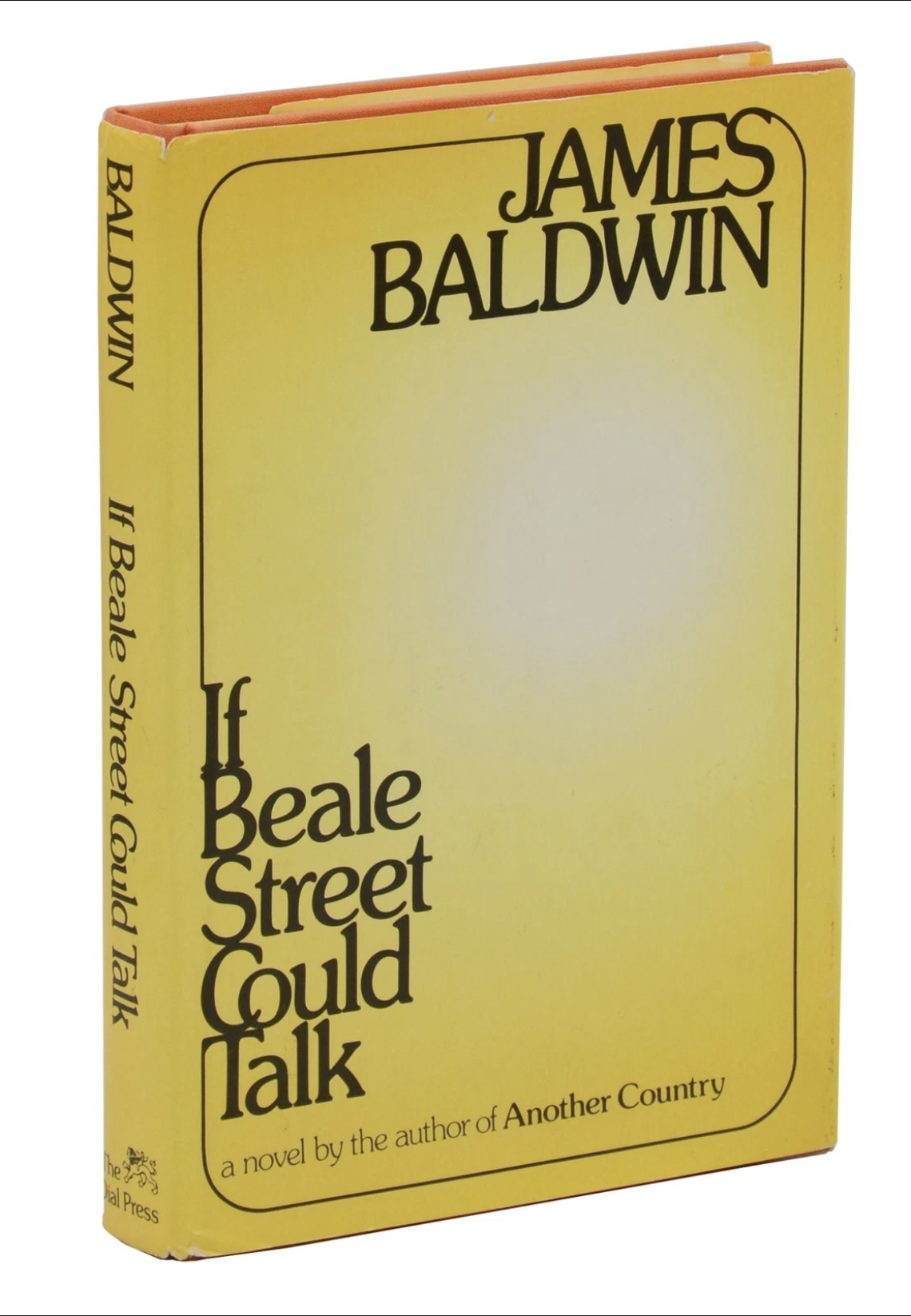
If Beale Street Could Talk — James Baldwin
James Baldwin
The Dial Press, New York · 1974
True First Edition · First Printing
The Book: True first edition, first printing. Original bright-orange publisher's cloth in the original unclipped $6.95 first-state dust jacket. The copyright page explicitly states “First printing,” and the jacket carries the correct publisher code 4169.
Condition: Near Fine book in Near Fine dust jacket. The jacket exhibits light age toning and minimal handling wear. The book remains exceptionally clean, with a tight binding, bright spine lettering, sharp corners, and no ownership markings or restoration observed.
Story Of The Book
James Baldwin shifted the conversation about racial injustice away from public speeches and courtrooms and toward the intimate human lives transformed by institutional power.
If Beale Street Could Talk follows Tish and Fonny, two young lovers whose future is interrupted when Fonny is falsely accused of a crime and imprisoned. Through their relationship and the family struggling to protect it, Baldwin examines racism not simply as prejudice or individual cruelty, but as something capable of operating through ordinary institutions—police, courts, prisons—and reaching into the most private parts of human life.
Published in 1974, after the landmark legislative victories of the Civil Rights Movement, the novel challenged any comforting assumption that legal equality had resolved America's racial conflicts. Baldwin instead turned his attention toward the criminal legal system, the presumption of guilt, and the consequences institutional injustice imposes upon individuals and families.
Why It’s In The Collection
The collection preserves printed objects that illuminate the relationship between individual humanity and systems of power. If Beale Street Could Talk approaches that relationship through fiction.
Baldwin makes wrongful imprisonment consequential not principally by arguing about policy, but by restoring humanity to the people who bear its consequences. Fonny is not reduced to a defendant or prisoner, and Tish is not merely someone affected by his incarceration. They are young people in love, imagining a home and a family, whose ordinary future becomes vulnerable to institutions possessing enormous power over their lives.
The novel therefore occupies an important place in the collection's exploration of civil rights, criminal justice, human dignity, and institutional power: it demonstrates literature's ability to make visible the individual human lives that systems of authority can otherwise reduce to categories, accusations, and statistics. This is the central reason recorded for the object's acquisition into the collection.
Collection Categories: Civil Rights · African American Literature · Free Expression · Criminal Justice · Witness Literature · Human Rights
James Baldwin
The Dial Press, New York · 1974
True First Edition · First Printing
The Book: True first edition, first printing. Original bright-orange publisher's cloth in the original unclipped $6.95 first-state dust jacket. The copyright page explicitly states “First printing,” and the jacket carries the correct publisher code 4169.
Condition: Near Fine book in Near Fine dust jacket. The jacket exhibits light age toning and minimal handling wear. The book remains exceptionally clean, with a tight binding, bright spine lettering, sharp corners, and no ownership markings or restoration observed.
Story Of The Book
James Baldwin shifted the conversation about racial injustice away from public speeches and courtrooms and toward the intimate human lives transformed by institutional power.
If Beale Street Could Talk follows Tish and Fonny, two young lovers whose future is interrupted when Fonny is falsely accused of a crime and imprisoned. Through their relationship and the family struggling to protect it, Baldwin examines racism not simply as prejudice or individual cruelty, but as something capable of operating through ordinary institutions—police, courts, prisons—and reaching into the most private parts of human life.
Published in 1974, after the landmark legislative victories of the Civil Rights Movement, the novel challenged any comforting assumption that legal equality had resolved America's racial conflicts. Baldwin instead turned his attention toward the criminal legal system, the presumption of guilt, and the consequences institutional injustice imposes upon individuals and families.
Why It’s In The Collection
The collection preserves printed objects that illuminate the relationship between individual humanity and systems of power. If Beale Street Could Talk approaches that relationship through fiction.
Baldwin makes wrongful imprisonment consequential not principally by arguing about policy, but by restoring humanity to the people who bear its consequences. Fonny is not reduced to a defendant or prisoner, and Tish is not merely someone affected by his incarceration. They are young people in love, imagining a home and a family, whose ordinary future becomes vulnerable to institutions possessing enormous power over their lives.
The novel therefore occupies an important place in the collection's exploration of civil rights, criminal justice, human dignity, and institutional power: it demonstrates literature's ability to make visible the individual human lives that systems of authority can otherwise reduce to categories, accusations, and statistics. This is the central reason recorded for the object's acquisition into the collection.
Collection Categories: Civil Rights · African American Literature · Free Expression · Criminal Justice · Witness Literature · Human Rights