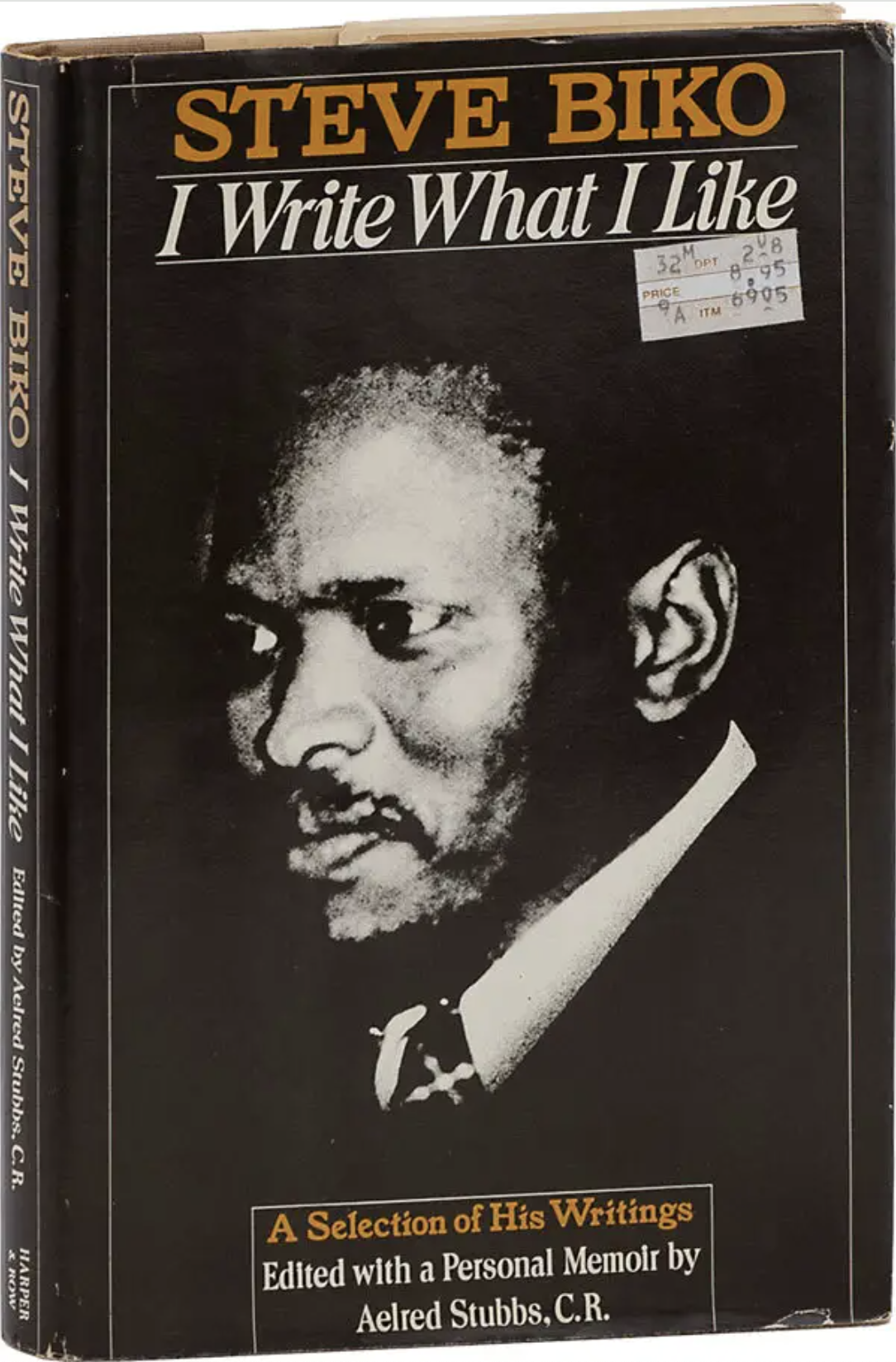
I Write What I Like — Steve Biko
Steve Biko
Harper & Row, San Francisco · 1978
First American Edition · First Printing
The Book: First American edition, first printing of Steve Biko’s I Write What I Like, edited with a personal memoir by Aelred Stubbs. The copyright page explicitly states “FIRST U.S. EDITION” and carries the complete first-printing number line ending in 1. Original publisher’s tan paper-covered boards over brown cloth spine in the original unclipped $8.95 dust jacket. No evidence of book-club manufacture, remainder marking, rebinding, or replacement jacket.
Condition: Near Fine book in Good+ dust jacket. The underlying book remains exceptionally clean with a tight binding and clean interior. The original dust jacket exhibits moderate edge wear, rubbing, several chips, and a substantial chip to the lower rear panel.
Story Of The Book
Steve Biko understood that political liberation could not succeed until psychological liberation came first.
As one of the principal architects of South Africa’s Black Consciousness movement, Biko argued that apartheid maintained itself through more than discriminatory laws, police power, and political violence. Oppression also depended upon persuading the people subjected to it to accept diminished ideas of their own identity, dignity, and possibilities.
I Write What I Like gathers Biko’s essays, speeches, and political reflections into the intellectual record of that resistance. His writings transformed dignity and self-definition into political principles, arguing that liberation required Black South Africans to reject the assumptions through which apartheid justified their subordination.
The circumstances surrounding the book’s publication make the object especially significant. Biko had been subjected to apartheid-era banning orders that severely restricted his ability to speak, publish, travel, and participate openly in political life. He died in South African police custody in September 1977. Published the following year, I Write What I Like carried writings that the apartheid state had attempted to contain beyond South Africa and into international circulation.
The state succeeded in killing Biko. It did not succeed in preventing his ideas from traveling.
Why It’s In The Collection
I Write What I Like embodies one of the collection’s central ideas: publication can allow a human voice to survive the power attempting to silence it.
This first American edition is therefore significant as more than a later collection of Biko’s writings. Because Biko had been prohibited from publishing freely under South Africa’s banning laws and died in police custody before many of these writings could reach an international readership, the book became part of the process through which his ideas escaped the restrictions imposed upon their author.
It also expands the collection’s examination of authoritarian power beyond censorship understood simply as the prohibition of books. Apartheid attempted to control Biko himself—where he could travel, whom he could meet, what he could communicate, and ultimately his physical freedom. I Write What I Like demonstrates the fundamental weakness of that strategy: ideas committed to print can continue circulating after authority has lost its ability to control the person who produced them.
The volume consequently stands as both a foundational intellectual document of the anti-apartheid movement and a powerful publication-event object in the history of political dissent, human rights, censorship, and resistance to authoritarian rule.
Collection Categories: Political Dissent · Human Rights · Anti-Authoritarianism · Political Movements · Anti-Colonialism · Witness Literature
Steve Biko
Harper & Row, San Francisco · 1978
First American Edition · First Printing
The Book: First American edition, first printing of Steve Biko’s I Write What I Like, edited with a personal memoir by Aelred Stubbs. The copyright page explicitly states “FIRST U.S. EDITION” and carries the complete first-printing number line ending in 1. Original publisher’s tan paper-covered boards over brown cloth spine in the original unclipped $8.95 dust jacket. No evidence of book-club manufacture, remainder marking, rebinding, or replacement jacket.
Condition: Near Fine book in Good+ dust jacket. The underlying book remains exceptionally clean with a tight binding and clean interior. The original dust jacket exhibits moderate edge wear, rubbing, several chips, and a substantial chip to the lower rear panel.
Story Of The Book
Steve Biko understood that political liberation could not succeed until psychological liberation came first.
As one of the principal architects of South Africa’s Black Consciousness movement, Biko argued that apartheid maintained itself through more than discriminatory laws, police power, and political violence. Oppression also depended upon persuading the people subjected to it to accept diminished ideas of their own identity, dignity, and possibilities.
I Write What I Like gathers Biko’s essays, speeches, and political reflections into the intellectual record of that resistance. His writings transformed dignity and self-definition into political principles, arguing that liberation required Black South Africans to reject the assumptions through which apartheid justified their subordination.
The circumstances surrounding the book’s publication make the object especially significant. Biko had been subjected to apartheid-era banning orders that severely restricted his ability to speak, publish, travel, and participate openly in political life. He died in South African police custody in September 1977. Published the following year, I Write What I Like carried writings that the apartheid state had attempted to contain beyond South Africa and into international circulation.
The state succeeded in killing Biko. It did not succeed in preventing his ideas from traveling.
Why It’s In The Collection
I Write What I Like embodies one of the collection’s central ideas: publication can allow a human voice to survive the power attempting to silence it.
This first American edition is therefore significant as more than a later collection of Biko’s writings. Because Biko had been prohibited from publishing freely under South Africa’s banning laws and died in police custody before many of these writings could reach an international readership, the book became part of the process through which his ideas escaped the restrictions imposed upon their author.
It also expands the collection’s examination of authoritarian power beyond censorship understood simply as the prohibition of books. Apartheid attempted to control Biko himself—where he could travel, whom he could meet, what he could communicate, and ultimately his physical freedom. I Write What I Like demonstrates the fundamental weakness of that strategy: ideas committed to print can continue circulating after authority has lost its ability to control the person who produced them.
The volume consequently stands as both a foundational intellectual document of the anti-apartheid movement and a powerful publication-event object in the history of political dissent, human rights, censorship, and resistance to authoritarian rule.
Collection Categories: Political Dissent · Human Rights · Anti-Authoritarianism · Political Movements · Anti-Colonialism · Witness Literature