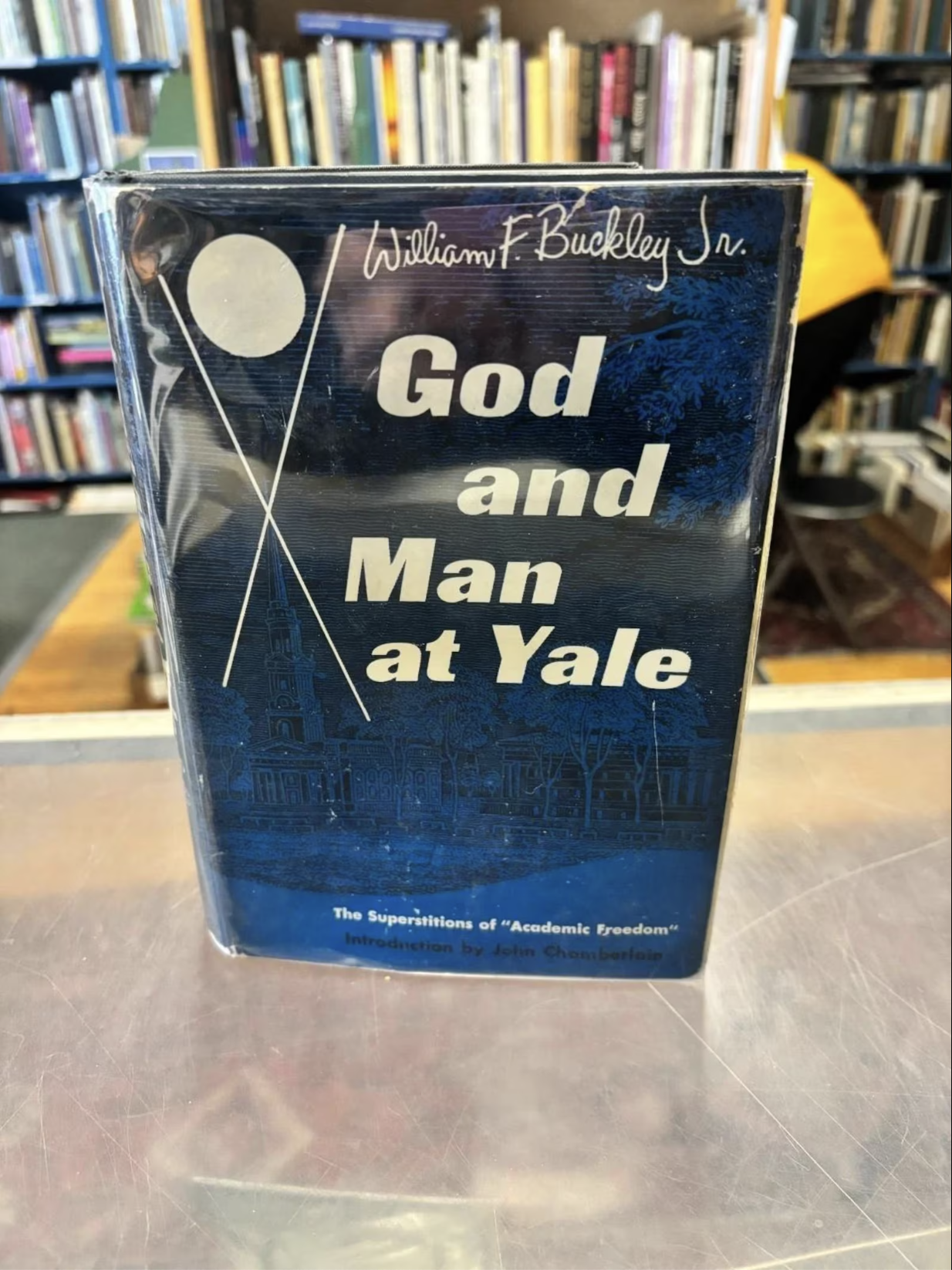
God and Man at Yale — William F. Buckley Jr.
William F. Buckley Jr.
Henry Regnery Company, Chicago · 1951
First Edition · First Printing
The Book: True first edition, first printing of William F. Buckley Jr.’s God and Man at Yale, published by Henry Regnery Company in 1951. Original publisher’s binding in the original first-state dust jacket. This copy is preserved in Very Good+ condition with its original jacket, an especially important component for the first edition. The volume was Buckley’s first book and the publication that launched him into national political and intellectual life.
Condition: Very Good+ book in Very Good dust jacket. The book remains clean and structurally sound with a tight binding and only light signs of handling and age. The original dust jacket exhibits moderate rubbing and edge wear, with small chips and short closed tears concentrated around the spine ends and corners, but remains substantially complete and presents well. No restoration observed.
Story Of The Book
William F. Buckley Jr. was twenty-five years old when he published an attack on one of America’s most prestigious universities—and helped launch a new conservative intellectual movement.
Published in 1951, God and Man at Yale accused Buckley’s alma mater of abandoning the religious and economic principles he believed its alumni expected the institution to preserve. But the book’s most provocative argument concerned something larger than Yale. Buckley directly challenged prevailing assumptions about academic freedom, arguing that a university’s claim to intellectual independence did not necessarily override the rights of the people who financially sustained it.
The subtitle made the provocation explicit: “The Superstitions of ‘Academic Freedom.’”
Buckley argued that Yale professors were using the protections of academic freedom to promote secularism and collectivist economics while insulating themselves from accountability to the institution’s trustees, alumni, and traditions. His proposed solution—that those who governed and financed private universities were entitled to exercise greater influence over what those institutions taught—placed him directly against competing conceptions of faculty autonomy and intellectual freedom.
The controversy made Buckley nationally famous. More importantly, God and Man at Yale anticipated an intellectual and political movement that would develop considerably over the following decades. Buckley would go on to found National Review in 1955 and become one of the central architects of postwar American conservatism. His first book preserves an early moment when that emerging movement began challenging the ideological assumptions of elite American institutions.
Why It’s In The Collection
God and Man at Yale belongs in the collection precisely because a collection about free expression should preserve serious arguments against its own assumptions.
Buckley did not write a conventional defense of academic freedom. He attacked what he regarded as its misuse and questioned whether faculty members at a private university possessed an overriding right to teach without meaningful ideological accountability to the institution that employed them. Those arguments create genuine tension with expansive conceptions of academic freedom—and that tension is what makes the book valuable here.
The collection is not intended to document dissent only when the dissenter reaches conclusions sympathetic to its broader values. Buckley was himself a dissenter confronting an institution he believed had become intellectually conformist. God and Man at Yale therefore forces a more difficult question: when competing groups claim intellectual freedom, who actually possesses the authority to define the boundaries of an institution’s permissible ideas?
As Buckley’s first book and an important early document of the postwar conservative intellectual movement, this first printing also preserves the argument at its original point of intervention. It provides an essential counterweight within the collection—an object that complicates rather than simply confirms its treatment of academic freedom, institutional authority, ideological conformity, and dissent.
Collection Categories: Free Expression · Academic Freedom · Political Dissent · Conservative Thought · Political Movements · Education
William F. Buckley Jr.
Henry Regnery Company, Chicago · 1951
First Edition · First Printing
The Book: True first edition, first printing of William F. Buckley Jr.’s God and Man at Yale, published by Henry Regnery Company in 1951. Original publisher’s binding in the original first-state dust jacket. This copy is preserved in Very Good+ condition with its original jacket, an especially important component for the first edition. The volume was Buckley’s first book and the publication that launched him into national political and intellectual life.
Condition: Very Good+ book in Very Good dust jacket. The book remains clean and structurally sound with a tight binding and only light signs of handling and age. The original dust jacket exhibits moderate rubbing and edge wear, with small chips and short closed tears concentrated around the spine ends and corners, but remains substantially complete and presents well. No restoration observed.
Story Of The Book
William F. Buckley Jr. was twenty-five years old when he published an attack on one of America’s most prestigious universities—and helped launch a new conservative intellectual movement.
Published in 1951, God and Man at Yale accused Buckley’s alma mater of abandoning the religious and economic principles he believed its alumni expected the institution to preserve. But the book’s most provocative argument concerned something larger than Yale. Buckley directly challenged prevailing assumptions about academic freedom, arguing that a university’s claim to intellectual independence did not necessarily override the rights of the people who financially sustained it.
The subtitle made the provocation explicit: “The Superstitions of ‘Academic Freedom.’”
Buckley argued that Yale professors were using the protections of academic freedom to promote secularism and collectivist economics while insulating themselves from accountability to the institution’s trustees, alumni, and traditions. His proposed solution—that those who governed and financed private universities were entitled to exercise greater influence over what those institutions taught—placed him directly against competing conceptions of faculty autonomy and intellectual freedom.
The controversy made Buckley nationally famous. More importantly, God and Man at Yale anticipated an intellectual and political movement that would develop considerably over the following decades. Buckley would go on to found National Review in 1955 and become one of the central architects of postwar American conservatism. His first book preserves an early moment when that emerging movement began challenging the ideological assumptions of elite American institutions.
Why It’s In The Collection
God and Man at Yale belongs in the collection precisely because a collection about free expression should preserve serious arguments against its own assumptions.
Buckley did not write a conventional defense of academic freedom. He attacked what he regarded as its misuse and questioned whether faculty members at a private university possessed an overriding right to teach without meaningful ideological accountability to the institution that employed them. Those arguments create genuine tension with expansive conceptions of academic freedom—and that tension is what makes the book valuable here.
The collection is not intended to document dissent only when the dissenter reaches conclusions sympathetic to its broader values. Buckley was himself a dissenter confronting an institution he believed had become intellectually conformist. God and Man at Yale therefore forces a more difficult question: when competing groups claim intellectual freedom, who actually possesses the authority to define the boundaries of an institution’s permissible ideas?
As Buckley’s first book and an important early document of the postwar conservative intellectual movement, this first printing also preserves the argument at its original point of intervention. It provides an essential counterweight within the collection—an object that complicates rather than simply confirms its treatment of academic freedom, institutional authority, ideological conformity, and dissent.
Collection Categories: Free Expression · Academic Freedom · Political Dissent · Conservative Thought · Political Movements · Education