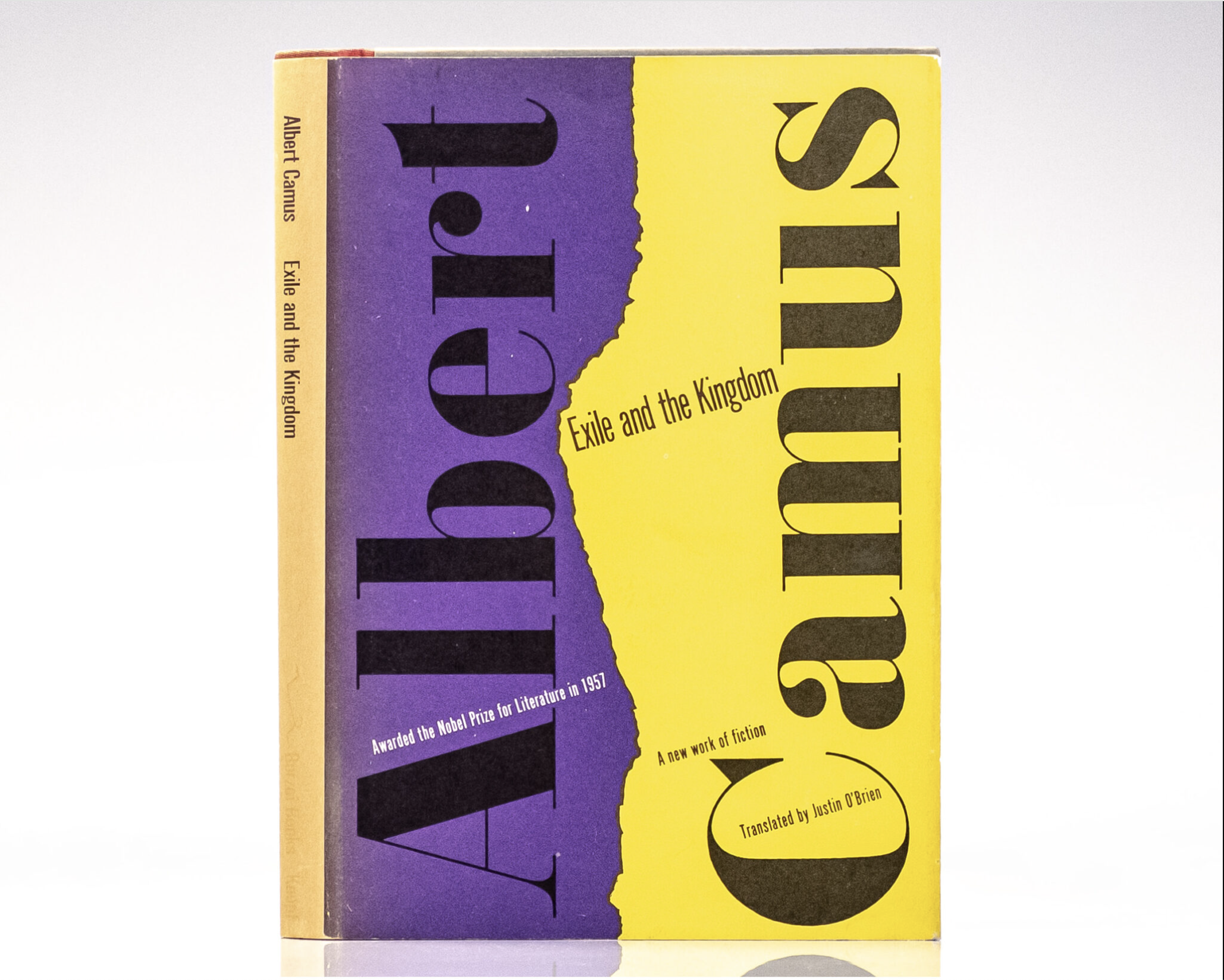
Exile and the Kingdom — Albert Camus
Albert Camus
Alfred A. Knopf, New York · 1958
First American Edition · First Printing
The Book: First American edition, first printing of Albert Camus’s Exile and the Kingdom. The copyright page explicitly states “FIRST AMERICAN EDITION” and contains no later-printing statement, consistent with Knopf’s first-printing practice for this edition. Original publisher’s cloth in the original Alfred A. Knopf Borzoi dust jacket retaining the $3.95 price. All observed bibliographic characteristics are consistent with the first American edition, first printing.
Condition: Near Fine- book in Very Good- dust jacket. The original jacket exhibits light edge wear, minor chipping at the spine ends, and mild rubbing. The book remains clean, tight, and structurally sound with light, even age toning.
Story Of The Book
Albert Camus spent much of his career confronting the grand political and philosophical questions of his age. In Exile and the Kingdom, he turned those questions inward.
Published in the United States in 1958, Exile and the Kingdom collects six stories centered on isolation, conscience, belonging, betrayal, responsibility, and the search for human dignity in an indifferent world. Rather than approaching freedom through manifestos or political argument, Camus examines it through individual moral choices made by people who often find themselves estranged—from society, from others, or from themselves.
The collection appeared at the culmination of Camus’s literary career, only months after he received the Nobel Prize in Literature. It was also his final major work of fiction published during his lifetime. In these stories, the philosophical concerns that shaped works such as The Stranger, The Plague, and The Rebel are translated into quieter, more intimate situations in which freedom and responsibility are tested at the level of ordinary human experience.
Why It’s In The Collection
Exile and the Kingdom belongs in the collection because it demonstrates that resistance to dehumanization is not always overtly political.
Camus’s characters confront alienation, moral uncertainty, loneliness, and the difficulty of acting responsibly when no ideological system can provide a complete answer. The stories repeatedly return to the tension between individual freedom and the pressures of society, history, and circumstance, preserving Camus’s broader insistence that human beings must not be reduced to abstractions.
Within the collection, the book provides an important counterpoint to The Rebel. Where The Rebel confronts totalitarianism and ideological violence directly, Exile and the Kingdom explores the quieter moral terrain that remains once those abstractions are stripped away: the individual person, alone with conscience, responsibility, and choice.
This first American edition therefore preserves both the publication event of Camus’s final major fiction collection and a deeply human extension of the anti-authoritarian values that run through his work.
Collection Categories: Literature · Anti-Authoritarianism
Albert Camus
Alfred A. Knopf, New York · 1958
First American Edition · First Printing
The Book: First American edition, first printing of Albert Camus’s Exile and the Kingdom. The copyright page explicitly states “FIRST AMERICAN EDITION” and contains no later-printing statement, consistent with Knopf’s first-printing practice for this edition. Original publisher’s cloth in the original Alfred A. Knopf Borzoi dust jacket retaining the $3.95 price. All observed bibliographic characteristics are consistent with the first American edition, first printing.
Condition: Near Fine- book in Very Good- dust jacket. The original jacket exhibits light edge wear, minor chipping at the spine ends, and mild rubbing. The book remains clean, tight, and structurally sound with light, even age toning.
Story Of The Book
Albert Camus spent much of his career confronting the grand political and philosophical questions of his age. In Exile and the Kingdom, he turned those questions inward.
Published in the United States in 1958, Exile and the Kingdom collects six stories centered on isolation, conscience, belonging, betrayal, responsibility, and the search for human dignity in an indifferent world. Rather than approaching freedom through manifestos or political argument, Camus examines it through individual moral choices made by people who often find themselves estranged—from society, from others, or from themselves.
The collection appeared at the culmination of Camus’s literary career, only months after he received the Nobel Prize in Literature. It was also his final major work of fiction published during his lifetime. In these stories, the philosophical concerns that shaped works such as The Stranger, The Plague, and The Rebel are translated into quieter, more intimate situations in which freedom and responsibility are tested at the level of ordinary human experience.
Why It’s In The Collection
Exile and the Kingdom belongs in the collection because it demonstrates that resistance to dehumanization is not always overtly political.
Camus’s characters confront alienation, moral uncertainty, loneliness, and the difficulty of acting responsibly when no ideological system can provide a complete answer. The stories repeatedly return to the tension between individual freedom and the pressures of society, history, and circumstance, preserving Camus’s broader insistence that human beings must not be reduced to abstractions.
Within the collection, the book provides an important counterpoint to The Rebel. Where The Rebel confronts totalitarianism and ideological violence directly, Exile and the Kingdom explores the quieter moral terrain that remains once those abstractions are stripped away: the individual person, alone with conscience, responsibility, and choice.
This first American edition therefore preserves both the publication event of Camus’s final major fiction collection and a deeply human extension of the anti-authoritarian values that run through his work.
Collection Categories: Literature · Anti-Authoritarianism