Eight Lectures on Labor, Capital and Justice — Charles E. Coughlin
Charles E. Coughlin
The Radio League of the Little Flower, Royal Oak, Michigan · April 1934
First Edition · First Printing
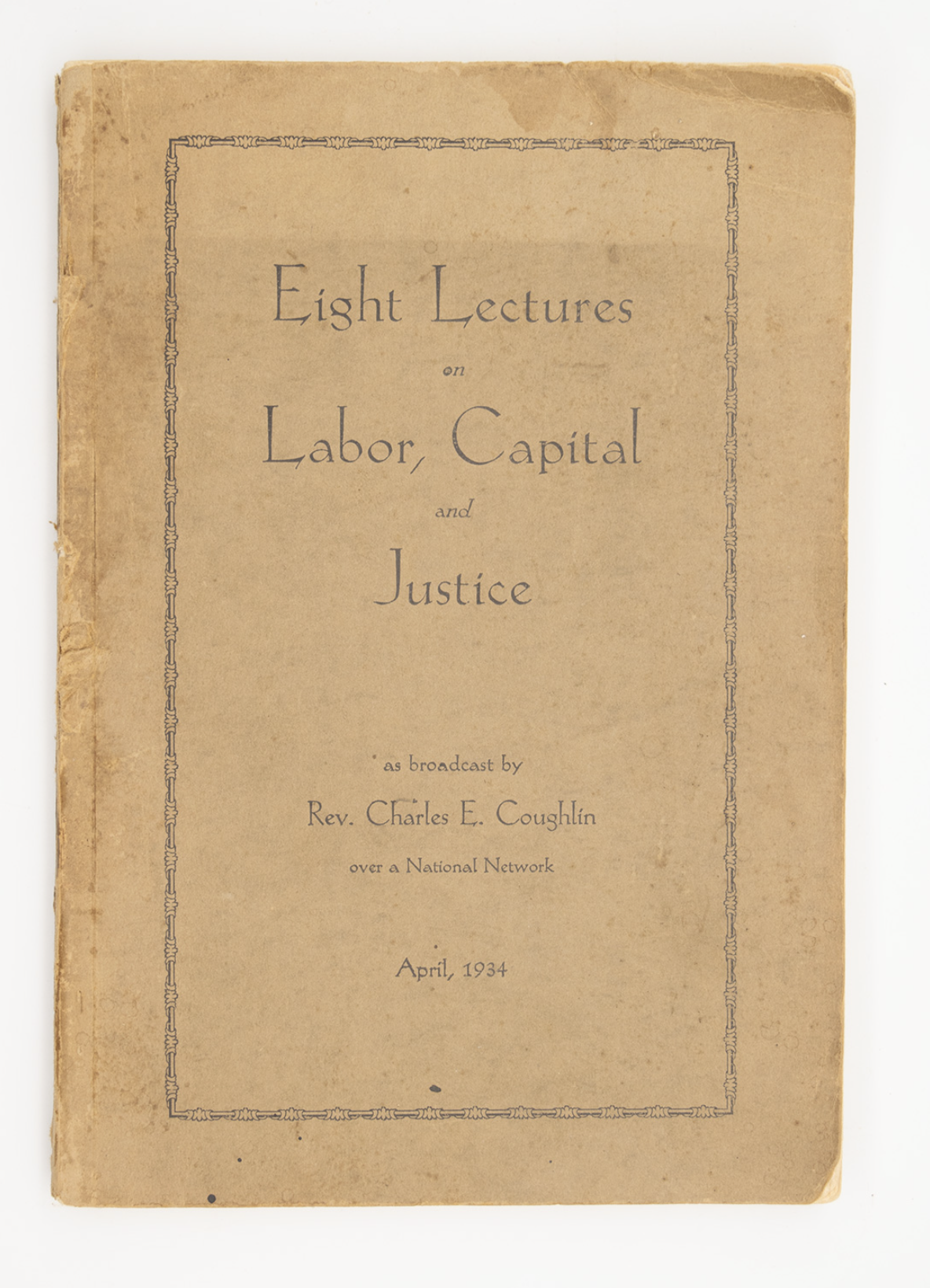
The Book: First edition, first printing of Charles E. Coughlin’s Eight Lectures on Labor, Capital and Justice. The title page credits “The Rev. Chas. E. Coughlin,” identifies The Radio League of the Little Flower in Royal Oak, Michigan as publisher, and is explicitly dated April, 1934 A.D. Original publisher’s stiff printed paper wrappers retained. No later-edition or reprint statement is recorded in the collection inventory.
Condition: Good. The original wrappers exhibit moderate toning, rubbing, edge wear, and a diagonal crease to the front wrapper, with significant wear and loss along the spine. A previous owner added contemporary handwritten identification to the spine. The sewn binding remains structurally sound, the text block is complete, and the interior is generally clean with moderate age toning.
Story Of The Book
Before political broadcasting became a permanent feature of American life, Charles Coughlin demonstrated how effectively a microphone could convert economic grievance into mass political influence.
Broadcast nationally during the depths of the Great Depression, the eight lectures collected here address unemployment, labor rights, monetary policy, banking power, private capital, and the moral responsibilities of economic institutions. Coughlin presented himself as a defender of workers and ordinary citizens against concentrated financial power, using radio’s unprecedented intimacy to carry political and economic arguments directly into American homes.
Published in April 1934, the volume appeared while Coughlin was evolving from a nationally known radio priest into an independent political force and before he organized the National Union for Social Justice later that year. His broadcasts eventually reached audiences numbering in the tens of millions, demonstrating radio’s ability to bypass established newspapers, political parties, and other traditional intermediaries.
The book therefore captures Coughlin at an important transitional moment. The economic populism preserved in these pages helped build the audience and political machinery that would later accompany the more extreme antisemitic and pro-fascist positions for which he became notorious.
Why It’s In The Collection
Eight Lectures on Labor, Capital and Justice belongs in the collection because it documents how new communications technology can reshape the relationship between political speakers and mass audiences.
The importance of the object is not that the collection endorses Coughlin’s arguments. It is precisely that his career demonstrates how dissent, populist grievance, mass persuasion, and political extremism can overlap. Radio allowed Coughlin to communicate directly with millions of listeners outside the traditional structures that had previously mediated political discourse, and the printed publication of those broadcasts extended their life beyond the moment of transmission.
This April 1934 first printing is especially valuable because it preserves an early stage in that evolution, before the later antisemitism and pro-fascist advocacy that would define Coughlin’s historical reputation had fully emerged. It documents the economic populism through which he initially built his following and therefore helps explain how a mass political audience can form before the ultimate direction of a movement becomes clear.
As both a printed record of nationally broadcast political speech and a publication-event object from the emergence of modern mass persuasion, the volume gives the collection an important counterexample: not every challenge to established power necessarily advances liberty, and the technologies that democratize expression can also magnify demagoguery.
Collection Categories: Political Movements · Political History · Labor & Economic Justice · Mass Media & Propaganda · Free Expression · Publication-Event Object
Charles E. Coughlin
The Radio League of the Little Flower, Royal Oak, Michigan · April 1934
First Edition · First Printing
The Book: First edition, first printing of Charles E. Coughlin’s Eight Lectures on Labor, Capital and Justice. The title page credits “The Rev. Chas. E. Coughlin,” identifies The Radio League of the Little Flower in Royal Oak, Michigan as publisher, and is explicitly dated April, 1934 A.D. Original publisher’s stiff printed paper wrappers retained. No later-edition or reprint statement is recorded in the collection inventory.
Condition: Good. The original wrappers exhibit moderate toning, rubbing, edge wear, and a diagonal crease to the front wrapper, with significant wear and loss along the spine. A previous owner added contemporary handwritten identification to the spine. The sewn binding remains structurally sound, the text block is complete, and the interior is generally clean with moderate age toning.
Story Of The Book
Before political broadcasting became a permanent feature of American life, Charles Coughlin demonstrated how effectively a microphone could convert economic grievance into mass political influence.
Broadcast nationally during the depths of the Great Depression, the eight lectures collected here address unemployment, labor rights, monetary policy, banking power, private capital, and the moral responsibilities of economic institutions. Coughlin presented himself as a defender of workers and ordinary citizens against concentrated financial power, using radio’s unprecedented intimacy to carry political and economic arguments directly into American homes.
Published in April 1934, the volume appeared while Coughlin was evolving from a nationally known radio priest into an independent political force and before he organized the National Union for Social Justice later that year. His broadcasts eventually reached audiences numbering in the tens of millions, demonstrating radio’s ability to bypass established newspapers, political parties, and other traditional intermediaries.
The book therefore captures Coughlin at an important transitional moment. The economic populism preserved in these pages helped build the audience and political machinery that would later accompany the more extreme antisemitic and pro-fascist positions for which he became notorious.
Why It’s In The Collection
Eight Lectures on Labor, Capital and Justice belongs in the collection because it documents how new communications technology can reshape the relationship between political speakers and mass audiences.
The importance of the object is not that the collection endorses Coughlin’s arguments. It is precisely that his career demonstrates how dissent, populist grievance, mass persuasion, and political extremism can overlap. Radio allowed Coughlin to communicate directly with millions of listeners outside the traditional structures that had previously mediated political discourse, and the printed publication of those broadcasts extended their life beyond the moment of transmission.
This April 1934 first printing is especially valuable because it preserves an early stage in that evolution, before the later antisemitism and pro-fascist advocacy that would define Coughlin’s historical reputation had fully emerged. It documents the economic populism through which he initially built his following and therefore helps explain how a mass political audience can form before the ultimate direction of a movement becomes clear.
As both a printed record of nationally broadcast political speech and a publication-event object from the emergence of modern mass persuasion, the volume gives the collection an important counterexample: not every challenge to established power necessarily advances liberty, and the technologies that democratize expression can also magnify demagoguery.
Collection Categories: Political Movements · Political History · Labor & Economic Justice · Mass Media & Propaganda · Free Expression · Publication-Event Object