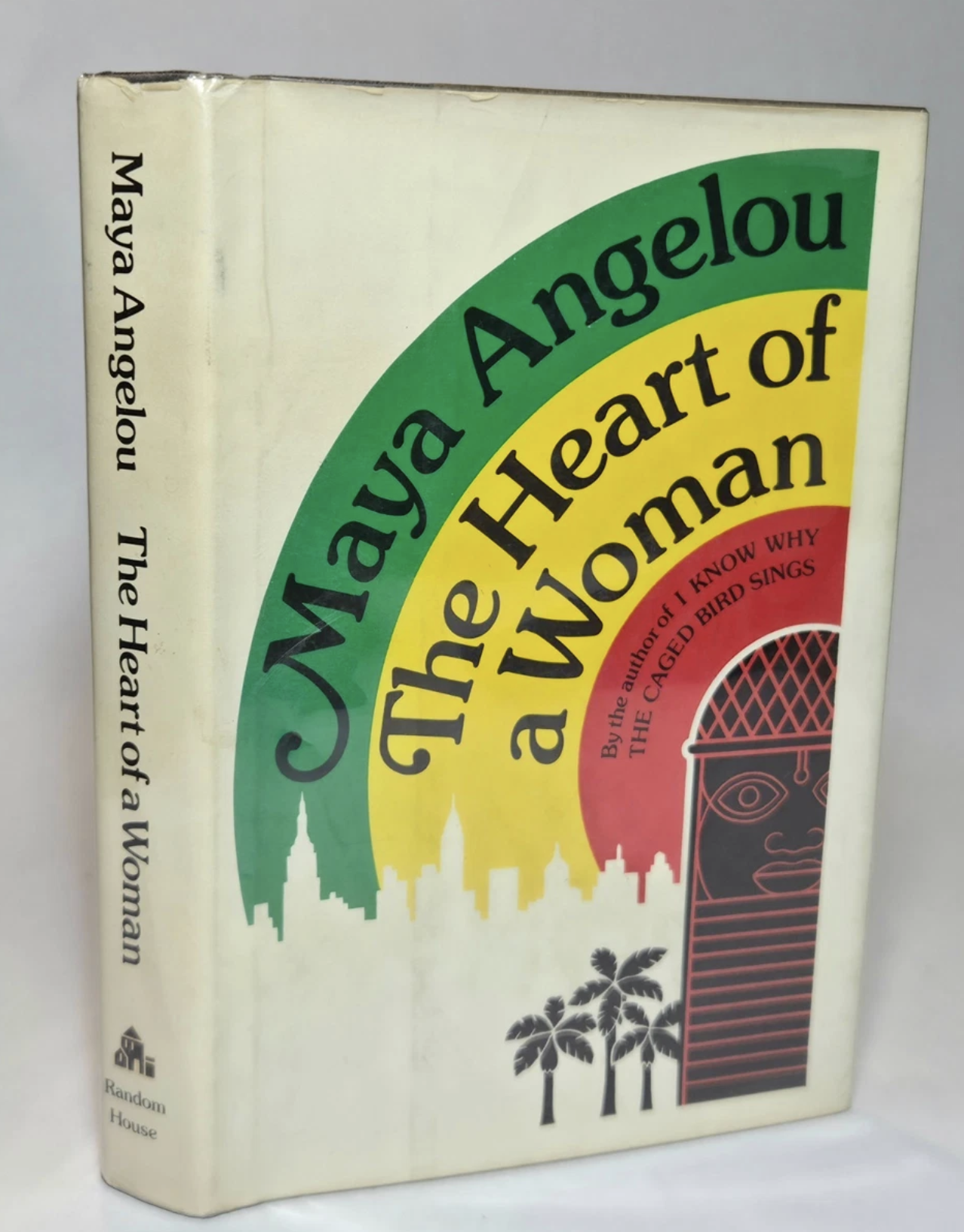
The Heart of a Woman — Maya Angelou
Maya Angelou
Random House, New York · 1981
First Edition · First Printing
The Book: First edition, first printing of Maya Angelou’s The Heart of a Woman, the fourth volume of her autobiographical series. The copyright page explicitly states “First Edition” and carries Random House’s first-printing number line, 24689753. Original quarter black cloth over gray paper-covered boards in the original first-state dust jacket. No evidence of book-club manufacture, remainder marking, or restoration.
Condition: Near Fine book in Near Fine dust jacket. The jacket exhibits light age toning with minimal handling wear. The book remains exceptionally clean, with a tight binding, bright spine lettering, and no ownership markings, foxing, or structural defects observed.
Story Of The Book
Maya Angelou refused to separate the story of her own life from the history unfolding around her.
Published in 1981, The Heart of a Woman chronicles Angelou’s life during the late 1950s and early 1960s, as her work as a writer, performer, mother, and activist increasingly intersected with the emerging Civil Rights Movement. Her account brings readers into the political and intellectual world surrounding figures including Martin Luther King Jr. and Malcolm X while preserving the movement through the perspective of someone who experienced it personally.
That perspective gives the book its particular power. The Civil Rights Movement is often remembered through speeches, marches, legislation, and the lives of its most prominent leaders. Angelou instead records the human existence surrounding those historic events—the relationships, responsibilities, uncertainties, sacrifices, and personal convictions of people whose ordinary lives became inseparable from a national struggle for equality.
The Heart of a Woman therefore does more than recount Angelou’s involvement in history. It preserves the emotional interior of a movement too easily reduced to its public milestones, demonstrating how political transformation is ultimately carried through individual human lives.
Why It’s In The Collection
The collection places particular importance on witness literature: works through which people who experienced consequential historical events preserved those experiences in their own voices.
The Heart of a Woman provides precisely that kind of testimony. Angelou was not a later historian reconstructing the Civil Rights Movement from archival evidence. Her autobiography preserves lived experience from within the political, cultural, and intellectual world of the movement itself.
It also advances one of the collection’s central concerns: restoring individual humanity to histories that can become abstract with distance. Civil rights history is ultimately not only the history of laws overturned or institutions changed. It is also the history of people who chose to participate, accepted personal consequences for doing so, and continued living complicated human lives while events later regarded as historic remained unresolved.
This first printing preserves Angelou’s testimony in its original book publication and gives the collection an intimate participant perspective on the struggle for racial equality, human dignity, and civil rights in twentieth-century America.
Collection Categories: Civil Rights · Witness Literature · Autobiography · Free Expression · African American History
Maya Angelou
Random House, New York · 1981
First Edition · First Printing
The Book: First edition, first printing of Maya Angelou’s The Heart of a Woman, the fourth volume of her autobiographical series. The copyright page explicitly states “First Edition” and carries Random House’s first-printing number line, 24689753. Original quarter black cloth over gray paper-covered boards in the original first-state dust jacket. No evidence of book-club manufacture, remainder marking, or restoration.
Condition: Near Fine book in Near Fine dust jacket. The jacket exhibits light age toning with minimal handling wear. The book remains exceptionally clean, with a tight binding, bright spine lettering, and no ownership markings, foxing, or structural defects observed.
Story Of The Book
Maya Angelou refused to separate the story of her own life from the history unfolding around her.
Published in 1981, The Heart of a Woman chronicles Angelou’s life during the late 1950s and early 1960s, as her work as a writer, performer, mother, and activist increasingly intersected with the emerging Civil Rights Movement. Her account brings readers into the political and intellectual world surrounding figures including Martin Luther King Jr. and Malcolm X while preserving the movement through the perspective of someone who experienced it personally.
That perspective gives the book its particular power. The Civil Rights Movement is often remembered through speeches, marches, legislation, and the lives of its most prominent leaders. Angelou instead records the human existence surrounding those historic events—the relationships, responsibilities, uncertainties, sacrifices, and personal convictions of people whose ordinary lives became inseparable from a national struggle for equality.
The Heart of a Woman therefore does more than recount Angelou’s involvement in history. It preserves the emotional interior of a movement too easily reduced to its public milestones, demonstrating how political transformation is ultimately carried through individual human lives.
Why It’s In The Collection
The collection places particular importance on witness literature: works through which people who experienced consequential historical events preserved those experiences in their own voices.
The Heart of a Woman provides precisely that kind of testimony. Angelou was not a later historian reconstructing the Civil Rights Movement from archival evidence. Her autobiography preserves lived experience from within the political, cultural, and intellectual world of the movement itself.
It also advances one of the collection’s central concerns: restoring individual humanity to histories that can become abstract with distance. Civil rights history is ultimately not only the history of laws overturned or institutions changed. It is also the history of people who chose to participate, accepted personal consequences for doing so, and continued living complicated human lives while events later regarded as historic remained unresolved.
This first printing preserves Angelou’s testimony in its original book publication and gives the collection an intimate participant perspective on the struggle for racial equality, human dignity, and civil rights in twentieth-century America.
Collection Categories: Civil Rights · Witness Literature · Autobiography · Free Expression · African American History